Showing posts with label Poetry. Show all posts

Tuesday, 7 April 2015

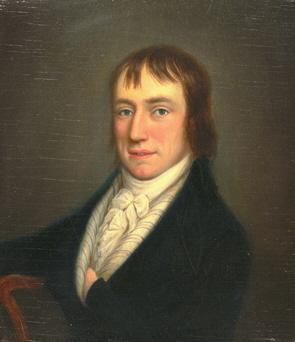
Happy Birthday William Wordsworth!

“Fill your paper with the breathings of your heart.” 
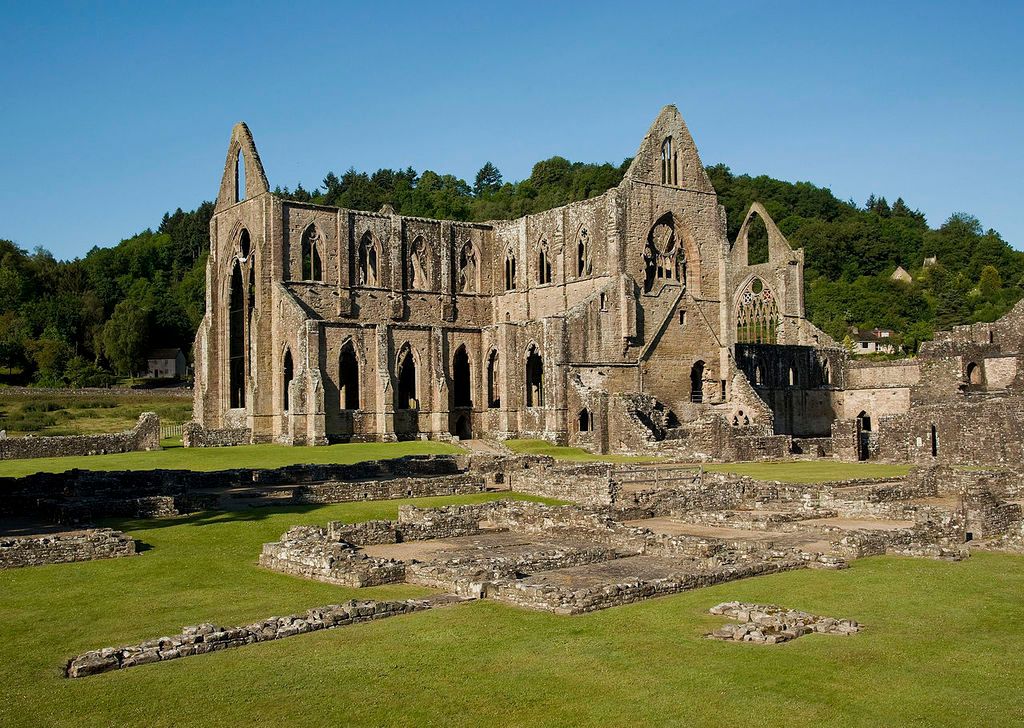
It seems fitting to share my favorite poem by William Wordsworth in honor of his 245th birthday (born April 7th, 1770): Lines Composed a Few Miles Above Tintern Abbey, On Revisiting the Banks of the Wye During a Tour. July 13, 1798 or simply referred to as Tintern Abbey. It is far too long to post but you can read it here

One of the most famous works to come out of the Romantic period was The Lyrical Ballads by Williams Wordsworth and his pal Samuel Taylor Coleridge--a collection of works by both poets first published in 1798 with a second edition published in 1800 (includes the preface). They were both determined to usher in a new-wave of poetry that would overturn the high-brow and neo-classical traditions of the 18th century. The explicit artifice found in the poetry of their predecessors such as Alexander Pope and John Dryden would be replaced with the stark-naked truth of human emotions. In the preface, Wordsworth describes poetry as "the spontaneous overflow of powerful feelings." He goes on to elaborate further that the mind undergoes a kind of transition from tranquility to contemplation but once that tranquility disappears, emotions take over and poetry is born. The combination of the "lyric" and "ballad" was wholly unique at the time--a hybrid genre that would take on the qualities of expressing personal and emotional feelings as found in the lyric with the oral traditions of the ballad (poems or songs narrating a story in short ballad stanzas that take on the form of quatrains). 

In order to make sense of Tintern Abbey, it is important to know a little more about what Wordsworth and Coleridge were attempting to achieve with the Lyrical Ballads. In the preface, Wordsworth describes the Lyrical Ballads as an "experiment," warning readers that the rough diction and lack of refinement may come across as strange or primitive in contrast to the older traditions. Nature and individualism take on a great importance for them. They wanted to focus on the universality of human emotions and on the lower classes to express their lives. Daily life was seen to be greater than common life; the poems often coloring ordinary situations with imagination. They wanted to bring poetry within the reach of the average person; writing in a colloquial language for the "common man" which in turn, becomes an artistic and political statement: 1) they will be original artists rather than copying others. 2) they can discuss subjects and issues that are not normally addressed in poetry such as domestic life or the rural poor. City life is viewed as problematic; the rise of consumerism and capitalism degrades the ability to appreciate nature. In a sense, Wordsworth and Coleridge see themselves as political reformers.

Now that I have provided some background information and context, it is time to jump into the awesomeness of this poem. Saving the best for last, Wordsworth decided to place Tintern Abbey as the final poem in the Lyrical Ballads. A good decision on his part. Hey, if you are going to attempt to kick-start a new literary movement, you might as well go out with a bang, right? Written in blank verse, there is a prosaic feel to this poem that is remarkable in its narrative flow, language, personal convictions, honesty and above all else, it's poetic ambitions. Wordsworth would later go on to write far more audacious works such as The Prelude along with the The Excursion, but Tintern Abbey appeals to me most for its emotional intensity and philosophical musings. No matter how many times I read this poem, it never fails to makes me fall in love with the beauty of poetry all over again. 

First off, it can categorized as a "prospect poem" which is usually bound to a particularized setting (usually outdoors) where the speaker engages in an internal dialogue with himself; putting on a hypersensitive and a superior point of view where consciousness is mediated through landscape--the unification of mind and the natural world. Such pensive contemplation and personal reflection evokes a process of memory, thought and anticipation of feeling. The speaker should achieve some kind of insight and the poem often ends where it began at the outer scene, but with an altered mood and deepened understanding. The emphasis on time is also important to the prospect poem, as evident here with the speaker reflecting on the past and the meticulous use of caesuras in the lines (pauses for dramatic effect) as a way of slowing down the flow of the verse.

As indicated by the long title of the poem, Tintern Abbey is an actual monastery that is located near the River Wye in Wales, which Wordsworth visited on several occasions throughout his lifetime. Built during the 12th century, the abbey is still standing today but is mostly in ruins. Landscape painting was all the rage during Wordsworth's time, especially in capturing the "picturesque beauty" found in nature. This particular style was advocated by many artists such as William Gilpin who sought to represent nature not in an idealized or artificial way but to show its roughness and imperfections. Ruined structures and distance between the artist and nature were of great importance to the picturesque. Looking down on the scene as opposed to looking up heightens the sense of the sublime (I can't seem to escape Kant) and we see that here in this poem. Wordsworth is not wandering around the ruins but is looking down on the Abbey from atop a hill as he composes the poem. It makes sense that Wordsworth would take some of these ideas of the picturesque in art and infuse it into his new brand of poetry.

View of Tintern Abey and the courtyard from the east.
There is an elegiac tone to this poem that is easy enough to recognize. The poem begins with the speaker lamenting the past as he returns to a familiar scene ("Five years have past; five summers, with the length/ Of five long winters!"), attempting to recapture the feelings of bliss and sense of tranquility he once experienced in nature at this very spot many years ago. He is soaking in the beauty of nature, which provides solace against all the pain and misery of the world. Similar to Gilpin's ideas of the picturesque, the natural world is being crafted by the artist, except Wordsworth is a poet and not a painter. The physical eye is connected to the mind's eye--the imagination: "These beauteous forms /Through a long absence, have not been to me /As is a landscape to a blind man's eye" (24-26). Even though he has been away from nature for so long, getting swept up in the hustle and bustle of city life, he is still able to recall their "beauteous forms" through the power of the imagination, which rejuvenates his soul (line 31: "tranquil restoration"). He proceeds to comment on being saved from absolute death through nature (lines 44-47) before making a grand philosophical statement about gaining a heightened sense of human understanding of the universe that can only be achieved through nature: "While with an eye made quiet by the power / Of harmony, and the deep power of joy, / We see into the life of things" (48-50). For Wordsworth, nature represents divine providence; where embracing nature leads to spiritual transcendence, the opening up of the mind beyond ordinary limits; a way to see the bigger picture so to speak. He admits to having doubts concerning these grandiose notions of the human mind and understanding of the universe but these wavering beliefs soon dissipate once he is able to fully commit his spirit to this greater power found in nature: "How oft in spirit, have I turned to thee / O Sylvan Wye! Thou wanderer through the wood / How often has my spirit turned to thee!" (57-59). 

The past and present collide as Wordsworth appreciates the scene in a new way than the first time he was here because he is now more mature (Line 84: "That time is past"). Lines 90-103 represents the fulcrum of the poem--the speaker outlines this new perception where the spiritual and divine can be glimpsed in the natural world; youth could not appreciate such phenomena or what Kant refers to as the "supersensible" feeling of the sublime. Divinity pervades all of nature; it becomes his anchor to the world, his spiritual guide, a moral teacher, showing the path to achieving a fulfilling life.

In the last stanza of the poem, the speaker goes on to say that even if he loses faith by not feeling the power of nature ("Suffer my genial spirits to decay"), he can still take comfort in his sister (122). He imagines Dorothy as this youthful and innocent being like he once was and he sees his former self through her. He makes the declaration that the social world cannot impose upon the natural world, imparting a legacy to his sister by the end of the poem--the connection and transfer from one being to another via nature. In essence, the speaker anticipates the future through his sister. While brooding on death, if nature does not renew him, he can live through the memory of his sister. The poem has now come full circle. Tintern Abbey is Wordsworth's definition of the "Greater Romantic Lyric" because poetry looks back in order to look forward.


Sunday, 5 April 2015

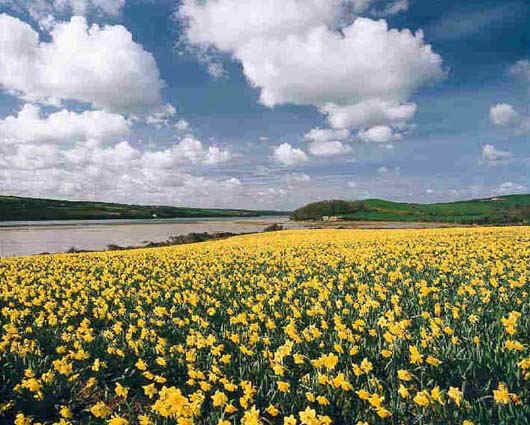
I Wandered Lonely as a Cloud by William Wordsworth

So purdy.
I wandered lonely as a cloud
That floats on high o'er vales and hills,
When alla t once I saw a crowd,
A host, of golden daffodils;
Beside the lake, beneath the trees
Fluttering and dancing in the breeze.

Continuous as the stars that shine
And twinkle on the milky way,
They stretched in never-ending line
Along the margin of a bay:
Ten thousand saw I at a glance,
Tossing their heads in a sprightly dance.

The waves beside them danced; but they
Out-did the sparkling waves in glee:
A poet could not but be gay,
In such a jocund company:
I gazed--and gazed--but little thought 
What wealth the show to me had brought:

For oft, when on my couch I lie
In vacant or in pensive mood,
They flash upon that inward eye
Which is the bliss of solitude;
And then my heart with pleasure fills,
And dances with the daffodils.

(Courtesy of The Poetry Foundation)

What better way to start off the Romantic Period for the Literary Movement Challenge than with a poem by William Wordsworth. I am obviously not the first person to point this out, but isn't it cool how one of the great poets from the 19th century happened to have the last name of Wordsworth. Not that a last name influences one's vocation but I always wondered if his last name were something more common like Smith. Would William Smith have gone on to become one of the preeminent figures of the Romantic Age or would have have chosen an illustrious career in Blacksmithing instead? Anwyays, I digress.

A few people have personally requested that I discuss more about poetry on this blog and while it may not be my area of expertise, hopefully I can offer some general reading techniques that have helped me to engage poetry on a more critical level, while at the same time, explain various poetic terminology along the way; taking a closer look at structure as as language, rhythm, meter, etc. that might help others who might be new to poetry and often find it difficult or intimidating. I am do not claim to be a literary critic like Stanley Fish or Cleanth Brooks with expert knowledge in poetry, capable of dissecting a poem to its bare essentials with such verve and brilliant precision. I am just a normal dude who likes to read and dabble in a bit of poetry of my own on occasion. My primary objective is to get others interested and excited about reading poetry. Therefore, it seems appropriate to start off a lovely and and relatively simple poem to see how one might pull off a close-reading. Alright, let's break it down.

I Wandered Lonely as a Cloud is a very famous poem but for those who may not be familiar with it, a bit of back-story. As I mentioned in the introductory paragraph, William Wordsworth was one of the forefathers of the Romantic era but how does one exactly define Romanticism? This is a difficult question to answer with any concrete explanation; thus, the focus should be on the possibilities of the genre. Some people might assume that this literary movement focuses on romance or 'love poetry' but that would be a misnomer. In a nutshell, the preceding Enlightenment period emphasized reason, science, order, constraint, a shared collective experience where rational thought supplanted superstition. Romanticism attempted to subvert these ideologies in favor of emphasizing the importance of self and personal experience; emotion/feeling, imagination, nature, freedom, inspiration--essentially, the rejection of rationalism. Obviously, having a basic understanding of the ideas and social/historical context of this or any other literary movement will be helpful to form an understanding of the poem but that is only one facet of critical analysis.

Using this poem as an example, we can see how several of these ideas are emphasized by the poet. Pay attention to the way Wordsworth shows how experience grows in the imagination ("inward eye") along with the sympathetic relationship between man and nature which is drawn from this personal experience. The subjective self is clearly important in establishing the epistemological arguments of the poem where knowledge can be advanced by shaping the imagination through the engagement of the environment. Nature--or more specifically, the daffodils--are linked to the patterns and grandeur of the universe. The poet forms a connection to the spiritual harmony of creation. In essence, the whole poem--event and interpretation--presumably comes as a presentation of real experience, preceding the act of composition, making up the materials of poetry. The juxtaposition between the actual work of a poet and his personal experience may be a very delicate and tenuous one but sometimes there is a very close correlation between the events and the poetry. This happens to be the case with this particular poem. Wordsworth lived most of his life in the Lake District, a fairly large rural area in England which is well renowned for its lush forests, rolling hills, picturesque scenery and enchanting waters. He would often take long walks around his home, soaking in the beauty of nature, using it as an inspiration for his writing. One of the end results is this poem. There is evidence that such an instance took place, recorded in the diary of his sister Dorothy, who accompanied him on one of these walks where they encountered a field of daffodils along the shores of Ullswater. Of course, Wordsworth clearly does more than merely report the scene (1802) in the poem that was eventually completed in 1804. We have the impression that the poet had the experience and then reflected on its significance at a later date before entering upon composition to write the poem. However, is not thinking about the original experience also qualify as material as much as the sight of the daffodils? 

Scansions (looking at poetic structure) is another effective way to tackle a poem--examining the aesthetics of language, meter and rhyming patterns can very useful to derive meaning. Let's look at the general structure of this poem then: it is divided into four stanzas, contains a rhyming pattern of ababcc and the meter is iambic tetrameter with slight variations (a fancy way of saying that each line contains four "feet" of unstressed/stress beats like this: da Dum, da Dum, da Dum, da Dum). How is this useful you might ask? Well, for starters, the specific rhythmic movement and cadences of language often serve to emphasize meaning in poetry. I don't want to get into the complex semantics of language but think about some of your favorite pop songs. They operate under their own specific rhythmic structure, containing a catchy chorus; particular words and lines emphasized or repeated for dramatic effect. I am not trying to suggest that "Wrecking Ball" by Miley Cyrus should be considered poetry, resembles or is in some way influenced by Wordsworth; but rather, to merely illustrate that the aesthetics of modern pop songs share a lot in common with poetic structure and form that may not be readily apparent. The use of repetition ("dancing," "gazed") personification, simile, alliteration and anastrophe (the literary device of inversion) is worth keeping an eye on in this poem. The use of specific words such as "host" (Line 4) cater to the poem's religious implications--the speaker's spiritual transcendence derived from nature with the daffodils representing the holy communion or heavenly "hosts" as angels.

Furthermore, there is a musicality to this particular poem not only in imagery (the "dancing of the daffodils") but in the actual lines themselves. Take a look at line 12: "Tossing their heads in a sprightly dance." The transition from the sight of ten thousand daffodils in the previous line (hyperbole) to "tossing their heads in a sprightly dance" produces the sense of awe in the speaker. Indeed, would could interpret his experience as witnessing the sublime in nature. Upon a closer inspection of this line, the verb "tossing" should be read as a trochee (stress/un-stress) instead of an iamb. The stress on this word is important because it highlights the specific movement of the daffodils, creating a whimsical feel through the bobbing and swaying of daffodils. One should also consider the use of dancing throughout the poem. Each stanza echoes a particular dance whether it be formal or patterned: the dance of conceptual movements--past to present, solitude to joyfulness, free-floating to grounded, ethereal to celestial, fanciful outer landscape of nature to the inner landscape of the mind and most importantly, the dance of visual observation to the powers of the imagination. The poem is a document in form and content; the speaker's intellectual movement from an observer to participant in a dance, revealing in the process, the harmonizing capacities of the imagination.


Tuesday, 24 February 2015

Astrophil and Stella: The Paradoxical Muse - Sonnet #64 and Sonnet #90

Sonnet #64:
No more, my dear, no more these counsels try;
Oh, give my passions leave to run their race;
Let Fortune lay on me her worst disgrace;
Let folk o'ercharg'd with brain against me cry;
Let clouds bedim my face, break in mine eye;
Let me no steps but of lost labour trace;
Let all the earth with scorn recount my case,
But do not will me from my love to fly.
I do not envy Aristotle's wit,
Nor do aspire to Caesar's bleeding fame;
Nor aught do care though some above me sit;
Nor hope nor wish another course to frame,
But that which once may win thy cruel heart:
Thou art my wit, and thou my virtue art.

Sonnet #90
Stella, think not that I by verse seek fame,
Who seek, who hope, who love, who live but thee;
Thine Eyes my pride, thy lips my history:
If thou praise not, all other praise is shame,
Nor so ambitious am I, as to frame
A nest for praise in my young laurel tree:
In truth I swear, I wish not there should be
Grav'd in mine epitaph a poet's name:
Ne if I would, could I just title make, 
That any laud to me thereof should grow,
Without my plumes from other's wings I take.
For nothing from my wit or will doth flow,
Since all my words thy beauty doth indite,
And Love doth hold my hand, and makes me write.

Disclaimer: I realize this is a very long essay but also don't expect many to read it anyways.

The use  of paradox is a recurring pattern of unity found in Astrophil and Stella. Sonnets #64 and #90 both employ this literary technique, developing a meditative discourse on the complex nature of poetry--more specifically, creative ambition, authorship and the ironic representation of Stella as the speaker's inspirational muse. Yet, the resemblance between the poems extends further than mere content. They each share a similar paradox pertaining to the speaker's literary aesthetic that is most vivid in the final rhyming couplet. Although both poems remain relatively analogous in subject matter, there exists a distinctive contrast in tone. Additionally, Sidney's specific use of language and metrical design highlights the speaker's shifting attitudes associated with the dramatic context of each sonnet.

The first lines of sonnet 64 begin with the poet's indignation towards his beloved: "No more, my dear, no more these counsels try / Oh give my passions leave to run their race" (1-2). Sidney's variation on the conventional iambic pentameter is worth noting in which he uses a spondaic substitution in the first line with "No More," as well as the repetition of this phrase to further underline the poet's ardent rejection of Stella's attempts to persuade him that in her view, poetry is inconsequential ("counsels"). One could also interpret the phrase "No more" as a trochee but to classify it as iambic seems erroneous, especially considering the context of these two lines: the speaker is clearly not apathetic towards Stella's approach, his temperament defiant and irascible to say the least. 

Sidney continues the metrical pattern of spondees and repetition with the subsequent lines (3-8) as the speaker emphatically lists a series of self-deprecating contrasts in order to justify his own poetic aspirations. Notice the ironic clash between the speaker's flippant irreverence towards himself and the provocation to defend his artistic sense of self. The repetition and heavy stress on the transitive verb "Let" announces the following rebuke of each line. The speaker's vigorous retaliation is emphasized by the patterns of rhythm--in other words, replacing the traditional iamb with a spondee gives the meter dramatic significance as the tensions in the first quatrain flow progressively into the second without a caesura until reaching the volta in line eight. The subtle irony of "Let Fortune lay on me her worst digrace" (3) and "Let me no steps but of lost labor trace" (6) shows the nihilistic progression in the escalating argument as it moves towards a potential resolution with line eight. Ostensibly, the speaker is pessimistic and discouraged to pursue his aristic endeavors by invoking "Fortune" with an ironic reversal. He personifies it as female ("her"), requesting that she bestow pain and misery upon him ("worst disgrace") rather than the typical benevolence or sanguine blessings associated with her character. However, with the line six, the cynical attitudes of the speaker shift towards an ironic sense of optimism. Despite the antagonism from "Fortune" herself, the intelligentsia ("folk o'erchaged with brain") and nature's disapprobation of his poetic efforts ("clouds bedim my face"), he still prefers to have attempted to master the craft even if the end result is unsuccessful The alliteration of "lost labor" us not just a stylistic decoration but actually serves an important purpose to unite the ironic contrast between these two ideas of artistic failure and achievement. More importantly, it stresses the tension between the speaker's conflicting attitudes.

Although line eight suggests a dramatic shift in tone from the first and second quatrain, it serves an other function to provide the poem's entire structure with equilibrium. The speaker's profound declaration of autonomy links the transition from pessimism in the first two quatrains with the third quatrain that that is far more idealistic by focusing on the subjective self: "But do not will me from my love to fly" (8). The implications of the line change depending on where the stresses are placed. It will hardly be disputed that "fly" is metaphorical, representing the creative imagination and the aesthetics of poetry. Therefore, if the phrase "my love to fly" is iambic, then it comes clear that he is rejecting any previous claim against his desire to purse a poetic vocation. he is determined to persevere against adversity in order to embrace his passion for poetry and no longer wants to be persuaded otherwise. But, if the line is interpreted as a spondee, then the heavy stress on "my love" suggests that the speaker is referring to Stella herself, which is plausible in the context of the previous line where he is attempting to reconcile the conflict between his desire to write poetry and her obstinate condemnation of this artistic lifestyle. Therefore, it can be understood as the speaker passionately advocating the compelling power of poetry to obtain Stella's affections. Sidney returns to this proposition explicitly in the rhyming couplet but uses irony to further to explore poetic ambition.

The metrical pattern in the third quatrain is slightly more irregular, although there is a trochaic substitution instead of a spondee at the beginning of each line. Once more, the speaker is categorizing a series of arguments but the tone is far less hostile and bitter. The repetition of the conjunction "Nor" serves a similar function to "Let" in the previous quatrains to set up defense within a dialogical framework towards a resolution--except, as indicated by the significant change in the speaker's attitude, he opts to persuade Stella by playing the pity card. if he does not model himself after great men such as Aristotle, Caesar or other successful poets as suggested by "though some above me sit" (11), then perhaps it will be easier for her (and others for that matter) to accept his desire to write poetry because they need not take his endeavors too seriously.

Line twelve is a slight reiteration of line eight, the speaker proclaiming his desire to peruse a poetic vocation: "Nor hope, nor wish another course to frame" (12). Moreover, the word "frame" contains highly charged connotations. Surely, it can refer to the speaker's fixed determination to set out on the journey of becoming a great poet ("course" as a verb reinforces this notion) but it is also meta-textual--a representation of the actual sonnet. To be more specific, the poem's intricate structure is enclosed within a "frame" of the iambic pentameter form, which then allows the speaker to "frame" his creative imagination as a means to articulate his ideas with the eloquence of language. Thus, the inevitable questions arises: are we to take the speaker as being ironic or sincere in his humble convictions of poetic aspirations? Considering the many contradictions and context of the poem, it is safe to assume that both answers are correct: he is feigning modesty to legitimize his poetic endeavors and is also serious in these claims. The rhyming couplet attempts to reconcile this ambiguity.

As we have seen so far, the tone shifts dramatically over the course of the three quatrains until finally reaching the resolution of the rhyming couplet. It is true that the poem contains a logical progression through a series of arguments to reach this climactic moment but the paradox seems to both contradict and support the speaker's poetic ambitions. With line thirteen, one notices that his primary motivation to experiment with verse is not entirely genuine because it comes across as a promiscuous strategy to persuade Stella to love him ("win thy cruel heart"). Additionally, the word "may" implies that he remains doubtful of his own talents to write with a level of sophistication and there is also a hint of skepticism concerning poetry in general as an impractical method to obtain romantic affection. The irony of the phrase "cruel heart" to describe Stella's predisposition supports this premise and produces a reversal in gender hierarchy where the male subject is now submissive to the woman. As indicated with subtly by the first line, she has already rejected his amorous advances because of his yearning to be a poet. Hence, from the speaker's perspective, the use of a spondee seems appropriate in expressing his wounded ego. Despite the preceding lines that attempt to defense his case, the tone evoked here (as supported by the rhythm and colloquial language) suggests both desperation and ambivalence.

Regardless of Stella's disapproval of his poetic methods, the last line retracts the cynicism of the previous one and places Stella in a positive light. He ironically proclaims her as his poetic muse ("thou art my wit") that influences his own virtue ("thou my virtue art"). Of course, we cannot simply accept the surface meaning of this line. Much like the rest of the poem, the rhetoric and alternation of tone is influenced by Sidney's specific use of language--in this particular case, the chiasmus of the word "art" has starling implications and reinforces the paradox of the these two lines. The cross-meanings of "art" can be understood in its simplest form (in contemporary vernacular it translates as "are" or "be") or by its usual association with creative expressive. Adopting this premise, "thou art my wit" becomes "thou art my wit" with a heavy secondary stress--that is, Stella not only provides inspiration for the poet but also through her divine "art" (or what will later be referred to as "love" in the last line of sonnet 90), she is elevated to the status of a goddess, having full control over his creative mental faculties. Following this logic, he is indebted to her artistic capabilities because he his channeling her talents through poetry.Furthermore, "thou my virtue art" undergoes a similar reversal of meaning where Stella's virtue is transformed into the speaker's art. Thus, the final paradox is now established: not only does Stella condemn his poetic vocation but she becomes his inspirational muse. As a result, he negates himself true authorship as an accomplished poet even though, of course, he is working self-consciously within the structural parameters of the sonnet form; evoking a parable about poetic ambition and the creative process. Phew.

Sonnet 90 recapitulates the paradox of sonnet 64 but is far more concerned with authorship. In contrast, the speaker addresses Stella more directly, the rhythm and tone appearing less irregular. The speaker maintains a much calmer and self-assured composure as opposed to his fluctuating attitudes in the previous sonnet. The opening line addresses Stella explicitly by name, reminiscent of line ten in sonnet 64 where he denies his poetic ambitions as being self-righteous: "Stella, think not that I by verse seek fame" (1). The word "fame" is used in both poems and contains essentially the same contextual meaning. He is formulating an argument to convince Stella that his main purpose in writing poetry is to express his affections and praise her virtue through creative means. Therefore, the first quatrain seeks to place Stella on a pedestal of admiration akin to idolatry, a similar technique used by Petrarch: "If thou praise not, all other praise is shame" (4). The speaker worships Stella as a goddess and believes it to be a serious disgrace ("shame") to not extol "praise" towards her beauty. Indeed, one can go further: this praise may also refer to his own literary ambitions because he intends to use poetic verse a panegyric in Stella's honor.

Yet again, Sidney uses the word "frame" from sonnet 64 in the second quatrain but here the metaphor is more explicit: "Nor so ambitious am I as to frame / A nest for my young praise in laurel tree" (5-6). The laurel tree is an obvious reference to poetic achievement where in the context of the previous line, the speaker subverts the established literary traditions by acknowledging that he possesses no desire ("nor so ambitious") to follow this path. Instead, he prefers to be a non-conformist and write poetry on his own terms. Consequently, the word "frame" also implies both his idiosyncratic poetic craft as well as the unconventional course of action he plans to take in achieving his creative goals. He admits to be aspiring poet, still in the developing stages and not yet fully confident in his abilities to seek adoration from others ("a nest for my young praise"). A similar argument is made in the third quatrain of sonnet 64 as the speaker attempts to make his poetic ambitions seem inconsequential. He follows the similar pattern of self-deprecation but his attitude is a little more pragmatic rather than cynical. He eschews with another literary convention by claiming to be undeserving in having his tombstone engraved with an inscription proclaiming him as a respected poet: "In truth I swear I wish not there should be / Graved in mine epitaph a poet's name" (7-8). Sidney seems to be suggesting here the possibility of obtaining immortality through poetic achievement. These lines become ironic within the thematic context of the entire poem because the speaker does in fact want to aspire to greatness as indicated by the third quatrain and final line.

The third quatrain sets up the central paradox of poetic authorship that becomes most fully realized in the rhyming couplet, beginning with the speaker denouncing himself as a charlatan: "That any laud to me thereof should grow, / Without my plumes from others' wings I take; / For nothing from my wit or will doth flow" (10-12). These lines eerily resemble the final line in sonnet 64 where the speaker refers to his "wit" as a byproduct pf Stella's influence. Here, one notices the bird feathers metaphor as representing the poet's lack of wit since he affirming to be a fraud by borrowing material from other poets. This line introduces the context for Stella as a paradoxical muse although it will not made explicit until the end. The rhyming couplet contradicts this statement by invoking Stella's divine literary powers in order to produce meaningful and original poetry but the speaker also contradicts himself again since the "plumes" may not be from other notable poets but from Stella. An underlying irony exists in line twelve as well and it also seems to be a direct reference to line fourteen in sonnet 64, which also deals with the concept of wit: "For nothing from my wit or will doth flow" (12). It is ironic; for the speaker is obviously self-conscious in the composition of the poem itself. He is not suffering from writer's block or else the poem would appear haphazard or unfinished. On the contrary, the verse is structured with precision and the imabic pentameter is relatively consistent despite slight variations in the stresses. If "wit" is to be understood as characteristic of one's mental acuity or skill as a poet, then it is difficult not to interpret this line as facetious: the speaker (or Sidney for that matter), clearly understand the fundamental principles of the sonnet form and is experimenting cleverly with language.

The rhyming couplet not only unifies the poem but links it directly with sonnet 64 with a similar paradox: "Since all my words thy beauty doth indite / And love doth hold my hand and makes me write" (13-14). Once again, the speaker invokes Stella as his muse, recognizing her divine influence. The tongue-in-cheek tone of voice in line twelve now shifts towards joyful exuberance as the speaker experiences an epiphany: he no longer needs to devalue his own sense of self-worth or struggle to compose anything of value because he lacks "wit" since Stella is now his muse. She is the creative spark in his mind, inspiring virtue and decorum. In line thirteen, her beauty stimulates his poetic imagination (along with his libido) and now his wit knows no bounds. Moreover, the transitive verb "indite" comes across as ironic too because it suggests that Stella is actually dictating the language of poetry to the speaker.

The ironic contrast is further emphasized by the final line, in which the speaker admits that Stella is responsible for the entire composition of his poetry because her "love" guides him through the creative process. The irony of line eleven now comes into focus since his relationship with Stella is paradoxical. Her influence "makes him write" but in order to compose eloquent and substantial poetry, he must take the angelic plumes from her wing, thus, she is beholden to his poetic achievements. Therefore, the rhyming couplet seems to be a more direct reiteration of line fourteen in sonnet 64: "thou art my wit, and thou my virtue art" (14). In both cases, Stella becomes a paradoxical muse for the speaker--she inspires his poetic craft and ambitions but her overwhelming influence destabilizes the concept of authorship where the title of "poet" becomes ambiguous. 

Monday, 23 February 2015

Astrophil and Stella by Philip Sidney


For the month of February, The Literary Movement Challenge focuses on the Renaissance. Initially, I was going to take the easy route and just read Shakespeare but he has already received more attention and scholarly research than any other literary figure in the English language--there really isn't much I can say about any of the bard's works that hasn't been said before. Therefore, I decided to read Astrophil and Stella by Philip Sidney instead: a sonnet sequence of 108 poems and 11 songs that predominantly centers around a lovelorn poet and his infatuation with a woman named Stella. That's a lot of freakin' poems! I knew that signing up for Fanda's reading challenge would  prove to be difficult right from the get-go; requiring a great deal of endurance and commitment on my part, but it finally sunk in after pushing myself to get through all of these poems, just how demanding it really will be in the long-run. Don't get me wrong, I have a strong affinity for poetry but this isn't exactly light reading and to cover such a large amount over a short-period of time was quite exhausting. Yes, I realize it would have been less strenuous to spread out my reading, get through a few poems a day and so on; however, time is always a factor and there is far too much ground to cover. Nevertheless, I did somehow manage to get it done but will surely need to take a long break from reading poetry.  

Anyways, let's get down to business. To simply label the Astrophil and Stella as a collection of love poetry would be an inaccurate assessment--rather, these poems are very complex and there is a lot more going on in them upon a close-analysis. It would obviously be impossible for me to do a write-up on every single one them so I have decided to provide some general thoughts on the collection as a whole and then do a close-reading of two personal favorites by contrasting them with one another. 

In order to better engage with this particular literary work it might help to have some basic knowledge concerning the social and political landscape during Sidney's lifetime, hence the reason for my including a brief historical context throughout this review. I apologize to those who might find such details superfluous or boring but then again, isn't one of the points of this challenge to learn about literary movements? The themes, philosophies, arguments, symbolism, allegories, allusions, motifs, rhetoric and specific structure of these poems is largely influenced by the period in which Sidney is writing. While it is true that authors cannot escape the time period they happen to be writing in, the Renaissance is one of those extraordinary times in human history where so much change was occurring rapidly; thus, it is worth examining closer to gain a clearer sense of Sidney's intentions and contextual framework. 

The Renaissance was a tumultuous period of radical change in England with the reign of Elizabeth I--socially, politically, religiously. This "re-birth" saw a revival of classical antiquity, humanism became a widely popular movement (Sidney being a strong advocate himself) and the English language underwent massive change as well. A new culture emerged from the ashes of the middle-ages: growing populations, increased rural migration to cities, the expansion of empires, discovery of the "new world", religious unrest in England with the the reign of Elizabeth who supplanted Catholicism in favor of Protestantism and a whole host of other changes such as increased attendance to universities and a complete revamp of the educational system. Attending university usually meant studying to join the clergy but now learning institutions were switching over to teaching "rhetoric" and humanism ("studia humanitatis"). As a result, literacy rates skyrocketed along with the stage and drama becoming popular art forms. 

Written sometime around the 1580's, Sidney never lived long enough to see his work published. Printing was fairly new and largely controlled by the monarchy through guilds. Therefore, like many writers of his day, Sidney only circulated his writings amongst close friends in the form of manuscripts. He held a high position in Elizabeth's court, even serving as the ambassador in Ireland. Only after being dismissed from court for causing a dispute with the Earl of Oxford and taking up residence in the countryside did he begin to write: Astrophil and Stella being one of several works that came out of this creative period in his life.


Like many other humanists, Sidney believed that literature and the poetic imagination as a moral obligation to better humanity, inspiring virtue and civility; a way to influence action, establish decorum, achieve personal advancement--the apotheosis of eloquence and dignity. It placed a great deal of attention on the autonomous individual, preferring the study of classics to natural sciences; a moral philosophy including rhetoric, poetry and history--rhetoric serving as a persuasive language, instigating opposition between classical culture and Christan culture. Humanism was still attached to medieval traditions but now that the focus was turning towards individual self-consciousness, Reason and not God became the universal moral guide for these writers and intellectuals. Talk about a radical shift in ideologies and literature. One of the questions this reading challenge proposes is to determine whether or not said author should be categorized within a particular literary movement. Considering Sidney was a humanist through and through, it is safe to say that he would be classified unequivocally as a Renaissance poet.  

He was well-versed in Latin and  idolized Petrarch--the quintessential love poet whose Il Canzoniere had a great impact on Astrophil and Stella. Fragmented and consisting of 366 poems, the bulk of sonnets deal with the speaker's love for a woman named Laura, the transformation of personal experience into poetry with the assertion of subjectivity and articulating secular love--the latter being the important aspect here since religious devotion and the praise of God's love was the primary concern found in most literary works at the time. For Petrarch, love is complex and paradoxical; creating division within the psyche, an on-going dialectic between desire and reason. One falls in love instantly as a Petrarchan lover, the image of "captivity" is a dominant metaphor; an idolatry element exists since the woman is often envisaged as a goddess or muse to the speaker. Ok, so what does all of this have to do with Astrophil and Stella? Well, if it is not obvious already, Sidney uses Petrarch's model as a foundation for his own poems but he does not simply mimic his predecessor; rather, he engages with an ongoing dialogue with Petrarchism, revealing a paradoxical relationship. The denial with one's affiliation with past poets and the affirmation of individuality is ironically conventional for Renaissance poets. Furthermore, the self-dramatizing lover shows up again who worships a woman, the embodiment of goodness and virtue. However, Sidney is far less regular in rhyme and meter, playing with expectation of narrative and psychological conflict (philosophical allegory, properties of the mind: reason, will, sense, etc) with a far greater emphasis on rhetoric. The sonnets follow the traditional 14 lines, with a rhyming couplet at the end but they are not all iambic pentameter as is common with the majority of Shakespeare's sonnets. They are designed in specific rhetorical units (Sonnet #1-35, Sonnet #36-72, Second Song to Sonnet #108) but Sidney plays around with the octet and sextet of the meter in contrast to Petrarch, who rarely deviates from an established pattern. Sidney steps away from the rough diction of Petrarch's generation with more attention on poetic effect and stylistic versification. Similar to Petrarch's  Il Canzoniere, Sidney's Astrophil and Stella is also fragmented with no consistent narrative logic and no definitive resolution at the end.

Many scholars have put forth the argument that the sonnets are biographical in nature, Stella being a pseudonym for one of Sidney's love interests named Penelope Rich, arriving at this conclusion because of the way many of the poems contain puns on the name of "Rich." Such claims seem pointless to me and it is far more interesting to examine the way Sidney cleverly plays with biographical allusions. Personally, the most fascinating aspects of these poems is the way they serve as psychological models, showing love as an internal battle; the  constant internal dialogue of the speaker preoccupied with determining the purpose of writing as well as attempting to establish poetry as a legitimate art form that can use the subject of love as a springboard and transform it into an eloquent philosophical discourse on the complex nature of human experience.