Monday, 9 March 2015

Crime and Punishment by Fyodor Dostoevsky


“Taking a new step, uttering a new word, is what people fear most.”

I have been meaning to write a review of Dostoevsky's masterful Crime and Punishment for ages but kept putting it off for mainly two reasons: 1) procrastination. 2)  my ineptitude at tackling such a complex novel. Now over two years have gone by and still I find myself in the exact same situation, struggling to come up with anything that might constitute a half-decent review that would do this novel justice. Then it dawned on me: I've been going about this all wrong. For the sake of posterity, this quintessential Russian classic has mesmerized readers for generations, firmly establishing its status as one of the greatest novels ever written. Thus, it would be an exercise in futility for me to attempt any sort of critical analysis that might shed some light on a particular aspect of the text that has yet to be recognized, since, an interminable amount of scholarly research has already been expended in that area. I could elaborate on the many ideas and various plots found in this thematically rich novel but that would be redundant as well. Therefore, it seems prudent to not focus on writing an elaborate essay but rather, present a less 'formal' review; one that is more delegated towards personal opinion. I can handle that.

First off, Crime and Punishment stands as one of the best novels I have ever read. Insert any number of superlatives here that typically follow such praise bestowed upon a literary work: powerful, brilliant, mind-blowing, beautiful, a work of genius! Indeed, all of these labels of approbation would apply. Second, as far as psychological character studies go, it is difficult to top Dostoevsky here. I have always found anti-heroes to be far more compelling; ones who battle their own personal demons, present an ethical conundrum, undergo an internal struggle as a means to rationalize their immoral behavior. The protagonist, Rodion Romanovich Raskolnikov (those Russian names sure are long and difficult to pronounce), is fascinating in this regard because even though he is despicable for having committed multiple murders (not a spoiler, the plot is well known), Dostoevsky manages to create sympathy towards him with great skill; or at least, make the reader question Raskolnikov's morality by exploring his troubled consciousness. As a rationalist, he attempts to justify murder but is driven to delirium, paranoia, even madness. His psychological turmoil is conveyed with such a striking intensity that is often exhausting on the part of the reader because the story is told primarily from Raskolnikov's point of view; thus, given direct access to his mind, we as readers, are placed in his shoes -- his suffering becomes our own. Raskolnikov struggles with the unspeakable evil of his crimes and there are plenty of religious ideas bouncing around but salvation does not come easy for him. 

On a final note, this brings us to the epilogue, which in turn, tends to be quite divisive amongst readers. Some will argue that it feels incongruous with the rest of the novel because of the dramatic shift in tone from nihilistic despair to hopeful optimism, emphasized by the ostensibly preposterous 'love conquers all' scenario. However, taking a closer look at the epilogue, I do not believe Dostoevsky's intentions were to show romantic love as the primary source for Raskolnikov's redemption, but more-so, the losing of himself in another person. Maybe I'm just a hopeless romantic and perhaps it does sound cheesy, but that does not make it any less true, at least from my own philosophical outlook. Prior to this pivotal moment, Raskolnikov was trapped within his own existential crisis, a prisoner of his own mind, living in a perpetual state of limbo. Lonely and depressed, he murders to release all of the frustration, inner strife and self-hatred plaguing his mind. This ennui and passivity is finally transformed into action. The pawnbroker just happens to be at the wrong place at the wrong time. Love can be inspiring, a powerful motivator and for the lucky ones, a reason to live. It's human nature to love and want to be loved. 

My initial apprehension in reading Crime and Punishment was largely based on the fact that it is a Russian text and I had a lot of difficulty deciding which translation would be most preferable. Rest assured, I do not harbor any xenophobic tendencies but there is no denying my predilection towards English-written literary works. I did a lot of snooping around the Internet, even posted on message boards asking others who were more familiar with the works of Dostoevsky, which versions they preferred -- all in the attempt to figure out which translations were considered the most 'accurate' in terms of keeping the original authorial voice intact. Unfortunately, I was unable to discover any general consensus on the issue. The most common response to my question was that it all came down to personal preference. Nonetheless, two big names did stand out though (well, technically three): Constance Garnett vs. the duo of Richard Pevear and Larissa Volokhonsky. Garnett was one of the first translators of Russian texts into English while Pevear and Volokhonsky have gained international fame for their more recent translations. After much debate, I finally chose to go with the latter. As someone who is not fluent in Russian, I have no idea whether or not their version holds sway over the others. Translations are a fickle business; they can never be perfect. Every language has its own unique linguistics with various syntax, semantics, phonetics, speech patterns etc. I'm no linguistics expert but reading Shakespeare in Chinese will obviously be interpreted completely different; the stresses in the lines in disarray; many of the subtle nuances in the language lost or non-existent. Furthermore, the translator always brings a certain level of bias towards any given text, even on a subconscious level. Their interpretation of the author's meaning may be slightly altered by their own personal views or perspectives on various issues; perhaps certain words or phrases of one language don't exist in the other, so they have to decide on the most viable substitutions. Once again, bias. 

Regardless of all these complications, I still think Richard Pevear and Larissa Volokhonsky did an excellent job with their translation of Crime and Punishment because as far as I can tell, the emotional nuances were not compromised. The protagonist's agony and mental distress is palpable; the intense feeling of dread and hopelessness conveyed with unflagging fervor. For those who might be intimidated by the great Russian writers like Dostoevsky, cast aside your fears and take the plunge. Like myself, you might happen to discover a whole new world of literature to explore. The Russians can be a temperamental bunch, that's for sure. But if you like your novels dark and brooding, full of penetrating existentialist and religious discourse, look no further than the Mr. Dostoevsky to deliver the goods. Crime and Punishment would be a perfect place to start.


This novel is part of my Classics Club Challenge.

Sunday, 8 March 2015

Deal Me in Challenge: The Turkey Season by Alice Munro

Gobble. Gobble.
Card Drawn: Queen of Hearts

A Nobel prize winning author, Alice Munro is often considered one of Canada's greatest literary treasures and a master of the short-story. She tends to receive nothing but the highest praise from critics and readers alike -- yet, she is the kind of author who seems to always remain under the radar. Her writing possesses a modest, gentle, demure, quiet and reserved quality that feels so...Canadian. 

Out of all the stories that I have read from the McClelland & Stewart collection edition of Alice Munro's Best Selected Stories, Turkey Season is my least favorite. I picked it out at random because the title seemed oddly amusing. This story comes across as an anomaly, not indicative of the author's commendable writing talents. In contrast to many of the other stories, this one does not showcase Munro at her best. Hey, we all have off days right? Even the best writers are bound to crank out few duds once in a while. 

Taking place in a small unnamed town, a woman reflects on her younger days during the 1940's when she gets her first job working at a turkey farm. Positioned on the killing floor, her station is responsible for gutting the turkey out and removing all its innards before being prepared to be shipped off for sale. Kinda gross. Looking back on some of my part-time jobs during high-school such as working at the movie-theater or doing binary at a printing company don't seem as bad in comparison. The narrator along with several of her female co-workers are fascinated with the foreman named Herb Abbott since he has a charming and attractive personality but they can't quite figure him out. He enjoys their company but ignores their flirtatious advances. He only seems to care about his job. The women begin to think that he might be a homosexual, his true colors hiding behind that rugged exterior. Christmas is the busiest time of year at the turkey farm, so the boss hires additional staff to fill the orders. One of these new recruits is a young man named Brian who disrupts the balanced order upon his arrival. What follows is of little importance, or at least, rendered inconsequential even though Munro was aiming to be profound in some way by employing ambiguity. She captures the sense of nostalgia with clarity and grace but there is a severe lack of emotional nuance to the story. 

With a detached narrative voice, the entire story is far too conservative, bland and stilted. Her writing style reminiscent of John Steinbeck in its simplicity and directness. She is usually capable of delivering emotionally charged stories containing subtle complexities but this is not the case here. Much like the turkeys gutted out by the narrator, this story feels hollow, dried out and severely undercooked.

Saturday, 7 March 2015

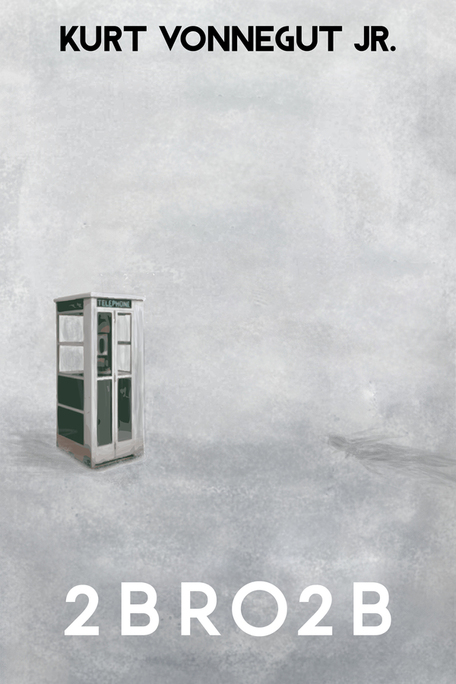
Deal Me in Challenge: 2BR02B by Kurt Vonnegut


Card Drawn: Ace of Clubs.

2BR02B. That is the question...

Is that not an awesome title or what? I couldn't have picked a better card from the deck to start the Deal Me in Challenge. Kurt Vonnegut is one of those authors that I have been meaning to read more from, especially since Slaughter-House Five is one of my favorite novels. He remains one of the best, if not the best, modern literary satirist of our time; an intelligent writer with a sardonic sense of humor and inimitable style whose caustic social commentary is thought-provoking as much as it is hilarious. I have always admired the talent of certain writers are able to write effective satire -- truth be told, not many come close to pulling it off with the sophistication and sharpness as Kurt Vonnegut. 

2BR02B would be classified as belonging to the dystopia science-fiction genre. The story takes place in the not so-distance future where population control is regulated by the state. There exist certain strict guidelines that must be followed concerning child-birth that involves...well, I've said enough already. Giving away the rest of the plot would ruin the fun of experiencing this wonderful story for yourself. Lately, I have been reading an exorbitant amount of short-stories to catch up with challenge (I'm currently 10 weeks behind, yikes!) and noticed several recurring patterns amongst a good portion of them: a sense of incompleteness, being abstract, haphazard, inchoate; essentially, they felt inconsequential. J.G. Ballard is a master of the short-story and he once said that "There have been plenty of perfect short-stories, but no perfect novels." He might be on to something there because 2BR02B is as close to a perfect short-story that I have ever come across. The novelist can get away with digressions, side-plots, elaborate descriptions or detailed exposition quite easily, but not the short-story writer. Crafted meticulously, Vonnegut doesn't fill the limited space with empty words; nothing is amiss or superfluous; he doesn't miss a beat. As always, his trademark wit and acerbic social critique hits all the right notes. However, it is the tightly wound story and stunning climax that left me in complete awe. What a brilliant ending! Many short stories seem disposable, like dime novels or pulp fiction. You read them once, get some kick out of it and then move on to the next one without dwelling much on it. 2BRo2B does not fall into that category and will linger in my mind for a long time to come.

Going back to that J.G. Ballard quote, it seems to be that great novels can be flawed because they have so much other story material to make up for their deficiencies whereas there is very little room for error when it comes to the short-story. The author must work within far more  rigid parameters, striving to be as concise as possible without compromising the integrity of the narrative. No easy task. Vonnegut somehow makes it look easy.

Friday, 6 March 2015

Book Blogger Hop: March 6th - March 12th

A few years back, I had a lot of fun participating in the Book Blogger Hop hosted by Billy at Ramblings of a Coffee Addict and was surprised to discover that it was still going on! Blimey, it kinda feels like stepping into a time-warp. Anyways, this is a great way to discover other book blogs and meet other bloggers. There is a prompt question provided each week that we are asked to answer. This one comes from Elizabeth: Do you think a book's title is important?

My answer:

Absolutely, positively, no doubt about it -- an unequivocal YES.  The function of a good title should serve two main purposes: to pique the readers interest and reflect the context of the story in some way. In certain cases, the title might appear superfluous for the sake of vanity, but it seems to me, that all those classics and all your favorite books almost always have the best titles. They capture the imagination immediately even without having any prior knowledge of what the story might be about. Of course, there are exceptions. Some of my favorite novels have pretty basic titles that don't really offer much in terms of deeper meaning: Saul Bellow's Herzog comes to mind -- it's just the last name of the protagonist.  

Once you start reading, the inevitable question arises: Why did the author choose this particular title in the first place? If it just so happens that you are reading a well-written novel, the title then becomes of great value because it can take on a host of different meanings; perhaps serving as a metaphor, representing important symbolism/imagery, emphasizing the main theme(s) or ideas that will later become crucial to understanding the novel's subtext. 

Some of my favorite book titles: Crime and Punishment by Fyodor Dostoevsky, The Bluest Eye by Toni Morrison, The Bell Jar by Sylvia Plath, A Scanner Darkly by Philip K. Dick, Sense and Sensibility by Jane Austen, As I Lay Dying by William Faulkner.

I could go on.

Thursday, 5 March 2015

Another Country by James Baldwin


“We all commit our crimes. The thing is to not lie about them -- to try to understand what you have done, why you have done it. That way, you can begin to forgive yourself. That's very important. If you don't forgive yourself you'll never be able to forgive anybody else and you'll go on committing the same crimes forever.” 

An astonishing contrast exists Richard Wright's Native Son and Jame's Baldwin Another Country. While both authors attempt to reconcile their socio-political beliefs as African- Americans and artistic vision as writers, their ideologies and aesthetic approach could not be more different. Richard Wright is a polemical writer; he's far more radical, expressing a lot of anger is his novel towards the dominant white society for the racial discrimination against blacks and less optimistic about social change without violent retaliation. In comparison, Baldwin preaches peace and love (perhaps living during the 60's and adopting a bohemian life style contributed to his philosophical outlook); he is more inclined to believe that not only blacks, but all minorities, should and will achieve equal rights and freedoms by co-operation and establishing grass-roots movements, not through violent measures. 

Richard Wright would likely denounce Baldwin as a coward and an idealist; someone living in a fantasy. Baldwin's rejoinder would be that Richard Wright compromises his artistic integrity for the sake of propaganda. Their confrontation would start to get really heated; vituperative remarks would pass back and forth but it is Wright who decides to throw the first punch. However, Baldwin is a diminutive giant, and with quick reflexes he dodges the left hook with relative ease. Wright is now fuming and frustrated with himself. He clearly underestimated this Baldwin fellow, who even as a heavy smoker, still manages to move around swiftly with plenty of endurance. He is going to need help if he has any chance of taking down his opponent, so he calls up his buddy Malcolm X who shows up almost immediately. Baldwin's confidence now begins to dwindle but even outnumbered, he has too much pride to back down. I'm a lover, not a fighter, he continues to tell himself. This is a losing battle so his only option is to run but doesn't get very far before being cornered. All hope seems to be lost and he is about to receive the beating of a life-time when all of a sudden, Martin Luther King swoops in right in the knock of time to save his friend! Dr. King is the voice of reason and he settles everyone down. He tells them that they are on the same side, fighting the same fight and there is no need for this silly quarrel. This is just what they want, he goes on to say. To turn on each other, to reinforce that racial stereotype of us being no more than animals fighting over scraps of meat. How can we fight for liberty, justice, equality and freedom if we have already destroyed ourselves? Baldwin is dewy eyed and doesn't say a word. Richard Wright and Malcolm stare incredulously at Dr. King. Hours seem to pass in silence before Richard Wright finally speaks: You fight your battle Doc, we'll fight ours. He and Malcolm turn around and walk away. Martin Luther shrugs and then helps his friend up to his feet before saying: "Well, that was fun. Ok Baldwin, I'll see you at the Washington Monument tomorrow, bright and early. And try not to be late this time."

On a more serious note, it doesn't surprise me that Another Country was met with much controversy at the time of its publication and was even banned in several countries (Australia being one of them; although one would think that it would have caused more of a stir on native soil). James Baldwin is unafraid to challenge the dominant ideologies of race and sexuality in relation to the African-American experience during the height of the civil rights movement in the early 1960's. The novel is very much a product of its time, the verisimilitude of hippie culture and emerging liberalism being depicted with perhaps a little too much self-conscious exuberance, but Baldwin's social and political ideas have lost none of their importance or relevance even today. His influence on the next generation of African-American writers like Toni Morrison is immeasurable. 

His writing possesses a raw intensity, an unflinching immediacy and vivid naturalism that bravely shows the ugliness of human nature. Although it is difficult not to view this novel within a historical context; the explicit sexuality (especially of a homosexual nature), rape, violence, vulgar profanity and drug use must have been incredibly shocking for readers at the time. Even by today's standards, Baldwin's subject matter is bound to raise a few eyebrows. He doesn't hold anything back. The title of the novel is perfectly ironic: Even though these characters live in America, they might as well be unwanted foreigners because they are black, oppressed by a hegemonic white society. They are outsiders, suffering from alienation and find themselves socially estranged in their own country. Even the white characters in the novel aren't immune to the hardships brought on my discrimination especially Vivaldo and Eric who have a homosexual relationship. Everyone shares an equal misery, confusion and despair. This is a depressing novel with no happy ending for anyone. Baldwin's main purpose is two-fold: to examine the America from a primarily black perspective in its most rawest form and to show the difficulties of maintaining human relationships in a world undergoing radical social change. With this novel, James Baldwin establishes himself not only as an important African-American writer, but as a dominant figure of 20th century literature.


This Novel is part of my Classics Club Challenge.

Wednesday, 4 March 2015

Native Son by Richard Wright


“Violence is a personal necessity for the oppressed...It is not a strategy consciously devised. It is the deep, instinctive expression of a human being denied individuality.”

A piercing sociological and psychological character study, very few novels come to mind that are as radical or uncompromising in their depiction of the black experience in America than Richard Wright's Native Son. Taking place in Chicago during the 1930's, the story is about the trials and tribulations of a young black man named Bigger Thomas who murders two women in a brutal fashion. The violence depicted in this novel is quite shocking and unsentimental, as it should be; Richard Wright is determined to produce conflicting emotions and ideas in the reader towards the protagonist's heinous crimes.  As far as the divisive issue of race is concerned, this novel has lost none of its historical, social or political relevance--it remains as important today as it did back in Wright's day when racial tensions were at their peak during the 1930's. The novel will attempt to present two different sides of the same coin: was Bigger Thomas compelled by his own free will to commit such heinous crimes or did society influence his actions? Wright spends a great portion of the novel focusing on Bigger's conflicted state of mind (reminding me a great deal of Dostoevsky's Crime and Punishment), while also showing the harmful effects of racial segregation--the struggle of suppressed individuals who feel trapped, unable to achieve any sense of self-worth, powerless in their efforts to achieve equality. After being conditioned to act subservient and feel inferior to whites for so long, what course of action is left for the black man but to strike back against his oppressors?

Richard Wright was ahead of his time. An important and influential novel, it is astonishing to me that he wrote it in 1940 before the civil rights movement even took off. He's also one hell of a writer, totally fearless. His dazzling prose is captivating, raw; possessing a relentless energy and purpose. As an irreverent iconoclast, he doesn't mince words or beat around the bush; unyielding to social norms, he intends to break down racial barriers, putting forth an honest representation of what it means to be black without any contrivances. Many detractors have dismissed this novel with vehemence, putting forth the argument that it only serves as a political platform for Wright to spew forth his left-wing propaganda. Yes, he can be preachy and heavy-handed at times but one must consider the historical, social and political context of when he was writing. His family members were ex-slaves, he lived during a time of great prejudice against blacks and racial segregation was a part of everyday life. He clearly has a lot of anger for past injustices and is strongly opposed to the degrading status of blacks living in America at the time. His writing reflects a revolutionary state of mind. He holds a vendetta against the "white man" and does blame the oppression of blacks squarely on the shoulders of a hegemonic white nation. He doesn't care much for subtlety when advocating Black Nationalism, using the brute force of a sledgehammer to drive home his radical political views. Thus, many readers are bound to find Wright's writing to be far too hostile and polemical in its motives. Approaching this novel with an open mind and maintaining a sense of cultural relativism by trying to place yourself in Richard Wright's shoes, might in fact, make it easier to understand where the author is coming from. How else is a persecuted race of people supposed to stand up to racial discrimination if they don't unite together and fight back? For Wright, violence is inevitable when individual freedoms are taken away. The destructive nature of self-hatred that arises from being oppressed by a dominant white culture, the fear and shame that comes with being black, racial blindness and how the dynamics of power is intrinsically linked to race are also of key concerns in the novel.

Bigger Thomas only views his actions within the context of race, never as an act of free-will: 

"The knowledge that he had killed a white girl they loved and regarded as their symbol of beauty made him feel the equal of them, like a man who had been somehow cheated, but had now evened the score" (155).

Subservient and ruled by his dominant white superiors, Bigger is never on equal grounds because of his blackness. Going through with the murders is a liberating experience, it provides him with a sense power, a feeling of wholeness and control over his own life that he was never able to achieve before.

He feels the same way concerning rape:

"Rape was not what one did to women. Rape was what one felt when one's back was against a wall and one had to strike out, whether one wanted to or not, to keep the pack from killing one. He committed rape every time he looked into a white face" (214).

Ashamed of being black, conditioned to feel inferior, treated like property, the painful reality of living day to day without any hope of bettering himself, Bigger's only escape from the bitter reality is to harness all the hate built up inside and lash out against the hostile world. Richard Wright is keen to emphasize the paradox of Bigger's life as a black man: murder is freedom. 

One last quote to highlight Bigger's sense of black identity:

"It was when he read the newspapers or magazines, went to the movies, or walked along the streets with crowds, that he felt what he wanted: to merge himself with others and be a part of this world, to lose himself in it so he could find himself, to be allowed a chance to live like others, even though he was black" (226).

Wow, powerful stuff.

A sprawling novel like this is bound to have certain flaws in terms of narrative flow, weighed down by extraneous details and lengthy exposition but they are far from detrimental. Starting off slow before gradually picking up steam, the first two sections maintain a frantic pace that is emotionally exhausting until the major turning point. Unfortunately, the final act loses momentum with too many didactic monologues, psychological examinations and court proceedings. Despite these faults, they are redeemed by the novel's emotional intensity, boldness and stark realism. Native Son is well deserving of its status as an American classic.  


This novel is part of the Classics Club Challenge.

Tuesday, 3 March 2015

Top Ten Tuesday: All-Time Favorite Books from the Past 3 Years


It's been a while since I've participated in the Top Ten Tuesday hosted by The Broke and the Bookish and this week's topic is far too enticing to pass up. At first, I thought that they meant to list your top 10 favorite books published within the last three years (which of course, would be impossible for me to do) but since this is not the case, it is a whole different ball-game. I have read a lot of great novels since 2013 and narrowing down my list proved to be a grueling process. However, I am fairly content with the end results:

  1. Herzog by Saul Bellow
  2. Crime and Punishment by Fyodor Dostoyevsky (review pending)
  3. The Lions of Al-Rassan by Guy Gavriel Kay
  4. Animal Farm by George Orwell 
  5. Tigana by Guy Gavriel Kay
  6. Fahrenheit 451 by Ray Bradbury
  7. Seize the Day by Saul Bellow
  8. Native Son by Richard Wright (review forthcoming)
  9. Everything is Illuminated by Jonathan Safren Foer
  10. Valis by Philip K. Dick  
Initially, I tried to include only one book per author but these constraints served no real purpose. As you can see, Saul Bellow and Guy Gavriel are the only ones to appear twice but their works are so exceptional that excluding them would only make me appear false to myself. 

If I were to make an arbitrary list consisting of my favorite novels of all time, Herzog would easily make the Top 5. In fact, my passionate adoration for this novel is so profound that I might even boost it up into the the top 3. I've read it twice now and currently making my way through it again for a third time. If this were Saul Bellow's only novel, I would have no qualms of proclaiming him as one of the great writers of the 20th century. Luckily for us, he wrote extensively over his lifetime and Seize the Day helps to confirm his status.


Crime and Punishment would likely make my top 10. I've been putting off writing a review for over a year now because I cannot possibly do this novel justice. Every single time I attempt to sit down and crank something out, my mind goes blank. I could easily bestow a heap of superlatives to describe many of its admirable qualities but that would come across as redundant--come on now, it's a Russian classic for a reason. However, I can state with the utmost confidence that it does rank as the most complex and intense psychological case studies on morality and religion that I have ever come across in a piece of literature. I really need to read more from Dostoyevsky.

If you have been following my blog at all, my rabid obsession with Guy Gavriel Kay has been well documented and I'm always eager to recommend his works to others. You won't find many authors as talented or original as him when it comes to the fantasy genre. I plan to organize a GGK read-a-thon in the near future, stay tuned.

George Orwell's allegorical masterpiece Animal Farm might seem all cute and fuzzy on the surface but it is a serious and important literary work that takes a firm stance against Marxist ideologies. I may not always agree with Orwell's political views but his general premise that communism only works in principle and not practice, is difficult to refute.

Ray Bradbury is probably more famous for his short-stories but Fahrenheit 451 has always remained at the top of SF's best novels of all time lists and for good reason. It's depiction of a terrifying world where books are considered a threat to the very foundation of a Utopian society because they encourage free-will and independent thought, has lost none of its relevance. The rise of totalitarianism through censorship, media control and our increasing reliance on technology, Bradbury's future seems right around the corner.

Richard Wright's unflinching portrayal of the black experience in his novel Native Son is so controversial, so thought-provoking, so powerful and so heartbreaking that it will remain an undisputed classic for many generations to come. It's scary to think that not a lot has really changed in 2015 concerning race relations in American since Richard Wright's time during the 1930's. Reading this novel today is a painful reminder that we still have a long way to go in achieving racial equality.

Everything is Illuminated defies accurate categorization. A truly original work from a young author that mixes fiction, autobiography, magical realism and history--the story is intricately written, flipping back and forth between past and present; combining an abstract epistolary narrative with a fragmented one that is most ingenious. In less talented hands, this convoluted approach would spell disaster but Jonathan Safren Foer somehow manages to pull it off swimmingly. I strongly believe that with enough time, he will be recognized one of the great writers of the new millennium. 

It was inevitable that Philip K. Dick would appear on this list. After all, he is my favorite SF writer and Valis proves once again why I hold him in such high regard. This novel is mind-blowing and for those who might be under the false impression that the genre has nothing substantial to offer in ways of originality or ideas, think again. 

Monday, 2 March 2015

Memento Mori by Muriel Spark


“Final perseverance is the doctrine that wins the eternal victory in small things as in great.” 

When Muriel Spark is on the ball, she is an absolute pleasure to read and Memento Mori showcases the author in top form. It's hard to believe that this is the sixth novel that I have read by her and now ranks as my favorite, closely followed by The Prime of Miss Jean Brodie. Graham Greene, one of my favorite authors, was a great admirer of Mrs. Spark and had nothing but high praise to bestow upon this novel: "This funny and macabre book has delighted me as much as any novel that I have read since the war." I am inclined to agree with Mr. Greene to a certain extent; the novel certainly has dark sense of humor but I wouldn't go so far as to refer to it as "macabre." Indeed, mortality and death is the central focus (Memento Mori in Latin translates to "remember you must die," hence the title and recurring punch-line used throughout the novel) but the gloomy subject matter is never presented in a morbid fashion, nor is the tone depressing or grim. Spark always maintains a sardonic sense of humor, using playful irony with such subtle skill that even when death does rear its ugly head, the outcome is both darkly humorous and surprisingly poignant. 

The premise is rather simple: a bunch of elderly Londoners begin to receive anonymous phone calls from a mysterious person who tells them "Remember you must die" before hanging up. The colorful cast of characters are all interconnected in some way; either through family relations, acquaintances or life-long relationships. The story unfolds in a similar fashion to a screwball comedy: quirky characters, fast-paced dialogue and outrageous situations that is light-hearted and entertaining. However, as in most of her novels, there is a lot more going on beneath the surface. Spark pokes fun at detective fiction by utilizing the classic "who done it?" scenario but subverts many conventions associated with the genre. A crime is committed, albeit a trivial one, and is blown way out of proportion. Instead of there being a damsel in distress, there is a dame in distress who is the most determined to discover the culprit behind the prank phone calls. Her older brother Godfrey who has a fetish for female suspenders along with his wife Charmian who used to be a famous author now suffering from dementia, are not nearly perturbed by the odd high jinks, while others find the whole charade amusing. One of the other main characters takes pride in collecting valuable data on the overall well-being of his geriatric circle of friends; obsessed with studying old age, embarking on a complex series of coded filing techniques to keep track of past relationships and personal histories as a reference just in case his memory starts to fade due to alzheimer's. See? Quirky. Furthermore, replacing the typical hard-boiled detective is a retired inspector who seems in on the joke, hired by the wealthy Dame to solve the case since the local police are reluctant to follow any leads. The Inspector is reminiscent of Edgar Allen Poe's famous C. Auguste Dupin who is always smarter than everyone in the room but once again, Spark is intent to play around with genre tropes. Instead of going into elaborate and painstaking detail of how he managed to solve the crime, Spark's detective is laid-back, nonchalant and embellishes in moral philosophy instead. 

Ostensibly, the whimsical story is an innocuous fable. However, Spark delivers an astringent satire on senior citizens and gerontology. In the wrong hands, this novel could easily have turned out to be one of those awful Saturday Night Live skits that tries too hard to be edgy and funny but is only embarrassing. Muriel Spark's saving grace is her brevity, sharp wit and talent for writing such great dialogue. The snippy back-and-forth banter between characters is positively droll. One of my main complaints about Spark's writing is that sometimes the characters are often one-dimensional, merely serving as props for jokes and running gags. However, with this novel, she finally manages to create an effective balance between the absurd and sentimentality. Even with her detached authorial voice that she uses frequently in her writing, Spark grants just enough depth to these characters to take them seriously even when they seem to be operating within the realm of the bizarre. Familiar Spark-isms crop up again: conniving characters, infidelity, black-mail, murder, upper-class snobbery and Catholicism but it is handled with such inventiveness that it does not come across as redundant for those who have encountered the author's work before. 

The afterlife obviously tends to be at the forefront of a lot of these character's minds because they are getting on in years, afflicted with health problems or living in retirement homes.  While most people would rather not think about their inevitable fate, these phone calls don't exactly help to calm the nerves of these poor individuals who are already well aware that Death is on the doorstep. Are the phone calls actually real or just early signs of senility often accompanied by old age? Is it a hoax played on the reader as well or perhaps a grand metaphor of some kind? I will not spoil the ending but in typical Spark fashion, she plays with the reader's expectations in such a clever way that brought a smile to my face. Dame Muriel Spark continues to surprise and delight.


Sunday, 1 March 2015

February in Review: Or how I froze my ass, returned to blogging and read a ton of poetry...

A frozen Lake Ontario.
February was bloody cold. Canadian winters are not for the faint of heart and if you don't take the necessary precautions, frostbite is the least of your worries. One of the biggest news stories in Toronto this month involved a 3-year old who wandered away from his home in the early hours of the morning and was found dead a few hours later, only a couple hundred meters away. Just tragic. I can't even imagine what it would be like to be homeless in this city. It's insane. Even bundled up in layers with a thick winter-coat, toque, heavy-duty boots and gloves doesn't prevent the cold from going right to my bones in a manner of seconds. Walking to work in this weather is no picnic, let me assure you. Nor is having to work in the back-room of a warehouse with the door always opening and closing. Then again, it could be worse right? How these homeless people are able to survive on the streets day in and day out in subzero temperatures is beyond me. Sometimes we take it for granted of how good we really have it. I may not have a lot of money but consider myself blessed to have roof over my head, central heating and food on the table. It's a privilege to be able to cozy up on the couch with a warm mug of hot-chocolate and a good book.

I am so glad February is now over because that means it should be warming up a little bit as we make our way into March. What a relief! I can't handle -30 temperatures anymore. Despite the lousy weather, February was a busy month for me, reading wise. It also marked my return back to the blogging world from a long hiatus. I'd like to take the opportunity to thank those individuals who expressed their concern, welcoming me back with kindness and support. You know who you are. It truly means a lot to me. 

I didn't manage to read as many novels this month because much of my time was devoted to reading a prodigious amount of poetry for the The Literary Movement Challenge and writing reviews/updating the blog. 

Total books read: 4

Storm Front (Dresden Files #1) by Jim Butcher
The Martian by Andy Weir (kindle)
Memento Mori by Muriel Spark
Carnival by Rawi Hage

Favorite novel of the month: Memento Mori

Poetry: Astrophil and Stella by Philip Sidney, Hero and Leander by Christoper Marlowe, The Miller's Tale by Chaucer.

Literary Criticism: A Defense of Poesy by Philip Sidney

Short stories: Alice Munro, Dorothy Parker, Kurt Vonnegut.

Overall, it was a productive month and I'm proud of myself for actually following through with a reading challenge for once. Granted, there is still January's Literary Movement to catch up on since I joined up late but I dread having to read anything from the medieval period. I can't stand Middle-English!  I also joined up for two other challenges (Reading England and Deal Me In) and hope to make a substantial dent in both of them during March.


How was everyone else's February? Did you reach your reading goals? Was there any new literary discoveries? Are you proud of any reviews/write-ups you did? Did you come across any interesting posts on other blogs? I sincerely hope you were able to stay warm at least!