Showing posts with label Deal Me in Challenge. Show all posts

Sunday, 25 October 2015

Deal Me In Challenge: Souls Belated by Edith Wharton


Card Drawn: 9 of Diamonds.

So much for my triumphant return in May only to make an appearance 5 months later...

To those few individuals who actually follow my blog, I offer my sincere apologies. It was never my intention to go completely AWOL but I am back for now and that is what counts, right?  Whether or not I will be able to provide new material on a regular basis is anyone's guess. Nonetheless, I figured the best way to ease back into writing reviews would be start off small to reignite my passionate enthusiasm towards literature and gradually build up momentum towards more extensive reviews. The Deal Me in Challenge is a great way to get started again. There still remains a little over two months to finish reading 52 short-stories for the year and I am determined to complete this challenge! 

Let me preface this review by saying that Edith Wharton is one of those highly-acclaimed authors whose writing never appealed to me in the least with a reputation that seemed completely undeserving of merit. In fact, prior to reading Souls Belated, I was quite certain that Wharton, along with her pal Henry James, might just be the two most overrated American writers during this particular time period. Despite its short length, reading Ethan Frome remains one of the most dull and painful reading experiences in recent memory. Both House of Mirth and Age of Innocence produced similar feelings of distaste and extreme boredom, which compelled me toss them aside after the first few chapters without any remorse. Suffice it to say, I approached Wharton with much trepidation, expecting to be  disappointed once more. Consider my surprise then to discover a wonderfully complex and emotionally compelling short-story that made me question my previous assessment of Wharton altogether. I will not go so far as to proclaim a complete change of heart but my resentment towards her as a writer has certainly subsided. I might even consider tackling one of her famous novels again sometime down the road. 

Similar to the many works of Henry James, Wharton adopts an "international theme" and sets her story in Europe rather than America. Lydia and Gannet are an American couple traveling abroad from Milan and elsewhere, all the way to France. When we first meet them on the train to Paris, an undeniable tension is brewing, ready to explode at any possible moment. They find themselves caught between their own sense of morality and the pressures of societal norms--factors which begin to cause a great strain on their relationship. What makes this story fascinating is not so much the actual story but the rich underlying subtext and emotional resonance that reaches its highest point during the climax. Wharton shows complete control of tone, influencing reader response through shifting focalization and ambiguity. The ending is purposefully left open to interpretation, carefully constructed with such vivid and meticulous descriptions that is nothing short of stunning. Rarely have I come across an author who uses the ellipsis in such a lyrical and profound way.

Wharton utilizes subtle nuances, symbolism, foreshadowing and ambiguity to emphasize some of the story's larger thematic concerns. She is critical of marriage as an institution--subverting many conventions associated with the"marriage plot" and is keen to highlight the superficiality of the upper classes. Gender politics, sexuality, male hegemony, paralysis vs. consciousness and hypocrisy are also worth paying attention to in the text. Even as a harsh social critique bound up in heavy drama, spots of ironic humor shine through Wharton's comedy of manners. The title of the story is important as well and loaded with multiple meanings associated with "souls": lost souls, spiritual souls, personal souls, soul mates, death. The standard definition of "belated" referring to lateness or delay of some sort, makes sense within the context of the relationship between Lydia and Gannet. Additionally, the word can also mean "archaic" or "old-fashioned" that further emphasizes Wharton's total disregard for traditional values and norms, which no longer have a place in the so-called "modern world." I may not be completely sold on Wharton yet but this is an excellent short story that contains a great deal of complexity and cleverly defies expectations. Highly recommended.

Monday, 6 April 2015

Deal Me in Challenge: Let Me Promise You by Morley Callaghan


 Card Drawn: 7 of Hearts.

Since I don't really have much to say about this short-story other than it was mediocre and completely forgettable, I made a meme instead that sums it up. Here is an interesting fact: not only was Morley Callaghan from my Canadian hometown of Toronto but he was also good friends with Ernest Hemingway back in the day. Pretty cool.

Friday, 27 March 2015

Deal Me in Challenge: A&P by John Updike


Card Drawn: 3 of Spades.

One might think that my luck has run out for drawing another 'short-story anthology card' from the deck but lo and behold, it actually turned out to be a blessing in disguise. Ladies and gentleman, I am proud to announce the first 5-star short-story since embarking on this challenge. As the great J.G. Ballard once said: "There are no perfect novels but there are some perfect short-stories" and only a few come to my mind: Ernest Hemingway's Hills Like White Elephants, James Joyce's The Dead, Flannery O'Connor's A Good Man is Hard to Find, J.D. Salinger's A Perfect Day For Bananafish, maybe even Shirley's Jackson's The Lottery. I feel confident in adding A&P by John Updike to that highly exclusive list. There are bound to be others but I am still on the hunt to discover them. To my mind, A&P represents a paradigm of the form and should be an inspiration for any aspiring writer who might have literary ambitions to dabble in short-stories. Or for those who might be curious to see how a masterful short-story is done, look no further. It is so polished and constructed with such painstaking delicacy but this only becomes apparent on a closer inspection. With understated craftsmanship, Updike somehow manages to redefine the short-story, perfecting the less-is-more technique with such exquisite nuance that left me in awe.

I can't believe it took me so long to finally read something by John Updike. As a preeminent literary figure of the mid-20th century, reaching international fame during the 1960's (along with others like Saul Bellow, Norman Mailer, Truman Capote Philip Roth, Harper Lee, etc), he remained on my radar for many years and it is embarrassing to admit that I have only recently discovered his brilliant writing talents. At the end of the introduction to his Early Stories: 1953-1975, Updike sums up his primary artistic vision as thus: "My only duty was to describe reality as it had come to me--to give the mundane is beautiful due." Keeping this in mind is a helpful way to approach his works but his writing is far too elusive and complex to be pigeon-holed into this one specific category. From what I can gather so far, he does tend to examine ordinary middle-class life with a microscope, often elevating the prosaic or banal into the sublime but he also happens to be a skilled prose stylist who uses language meticulously for dramatic effect. 

So, what is this story about exactly? Well, on its surface, the story is pretty simple. It takes  place at a grocery store (hence the title, for those who may not be familiar with American grocery-store chains) in a sleepy Midwestern town, narrated by one of the young male employees who works there. His boring shift starts off like any other except on this particular day, he is roused from his complacent stupor when three girls walk in wearing only their bathing suits. I'll leave the summary at that. What follows is an acerbic and razor sharp social critique of middle-class values that is unexpectedly poignant. I could easily write an extensive essay on the sociological underpinnings of the story from a Marxist perspective or on the way Updike handles gender. Or what about the importance of Updike's specific use of language and narrative devices? There is so much to discuss and endless interpretations but I'll let the story speak for itself. That ending though...talk about pitch-perfect. Some might view it as cynical but not me: It is the absolute TRUTH of the indifferent capitalist society we live in.

After doing a bit of research, it turns out that A&P is one of Updike's most famous stories, his most widely anthologized and one that has been taught in college classrooms since it's release in 1961. It's reputation does not surprise me but it is strange that I have not heard about it until now, John Updike was never mentioned once during my 20th century lit or short-story courses during university, nor does his name carry the same amount of prestige it might have when he was at his peak. Updike seems to have all but faded from public consciousness or at least it feels that way. I am beginning to wonder if he wrote anything else that could possibly match or come close to reaching the level of excellence achieved by this short-story. I aim to find out. Nonetheless, if he is still widely read and praised for his literary virtues, this is surely being carried out on the down-low.


Monday, 23 March 2015

Deal Me in Challenge: The Passenger by Vladimir Nabokov

"Our imagination flies -- we are its shadow on the earth.” 
Card Drawn: 7 of Diamonds.

What a brilliant piece of meta-fiction! Lolita is one of my favorite novels but I had yet to read anything else by Vladimir Nabokov...until now. The Passenger is such an intelligent and clever short-story that plays with the readers expectations of narrative conventions. In a sardonic and cheeky fashion, Nabokov designs an elaborate ruse to test the reader's response to fundamental narrative principles that have been indoctrinated into our learning and understanding of stories since we first learned how to read. Despite one's fondness for the abstract or experimentation in literature, most people, myself included, prefer a story with an arch plot: A-B-C. Perhaps not always in that order but we expect the author to tell a story that follows a certain narrative logic and moves forward towards a satisfying conclusion. How many times have you started a book and in the first opening pages, you have already established a general idea of where the story is heading, can anticipate various plot developments and can predict the climax? I would expect that this happens quite often. 

Our voracious appetite for story has made us incredibly perceptive readers. We seem to encounter the same stories over and over again, just told differently. We have become experts on particular genres, grown familiar with the various tropes, archetypes, themes, symbolism and other conventions associated with said genre. Hence, whenever we first encounter a story, our subconscious mind is already working out the details, conjecturing what comes next with almost pinpoint accuracy. It's kind of scary.  However, it is source of great amusement and pleasure when reading a story that is unpredictable, offering something new that we have never encountered before. Vladimir Nabokov's The Passenger is one of those rare gems that defies expectations; or at least, it did for me. While it may seem as if every story has already been told, genres saturated to the point of agonizing cliches and literary talent in short-supply, I believe that originality still exists--this is certainly the case here. I will not bother going into the details of the actual story because that will obviously ruin the fun of experiencing it on your own. As an experienced reader, do you think that you are smarter than most authors? I don't mean in terms of intelligence, knowledge or writing talent but in the ability to surmise their intentions and predict the plot with startling precision. Track down this short-story and see if you can beat Nabokov at his game. 

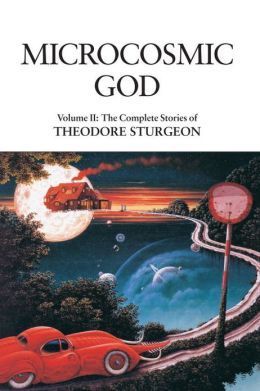
Deal Me in Challenge: Microcosmic God by Theodore Sturgeon

These vintage Sci-Fi covers are so cool.

Card Drawn: Jack of Spades.

Theodore Sturgeon is one of those dominating figures of the Science-Fiction genre who has yet to really impress me. Prior to this short-story, I had read two of his novels: Marry to Medusa and More Than Human--both decent but lacking a certain level of finesse that would otherwise propel him to greatness in my eyes. Sturgeon's ideas and unique approach to the genre is far more appealing to me than his actual writing.

In his introduction to The Complete Stories of Theodore Sturgeon Vol. I, renowned Science-Fiction/Fantasy author Gene Wolfe writes, "The first [sf] story I read was 'Microscopic God' by Theodore Sturgeon. It has sometimes occurred to me that is has all been downhill from there." High praise, indeed. However, I must disagree with Mr. Wolfe's estimation of this particular short-story, which to my mind, is not nearly deserving of such a distinguished accolade. Surely, the story is adequate enough and contains certain positive attributes but let's be reasonable: there are so many better short-stories from this genre out there. Clearly, such an argument is a matter of personal opinion. While I do appreciate Sturgeon's attempt to deliver an interesting spin on 'mad scientist playing God' story-line, which goes far back as Mary Shelley's Frankenstein, the writing is choppy, sporadic and wildly uneven; more often than not coming across as amateurish. Perhaps Sturgeon can be forgiven for these blunders since this was one of his earliest attempts at writing, first published in"Astounding Science-Fiction" in 1941. With the outbreak of WWII, it is interesting to view this work within a social and historical context. The rapid advancement of nuclear technology proved to be a dangerous threat to the extinction of humanity and Sturgeon's work can certainly be interpreted as a parable or allegory, suggesting a certain level of fear for the future because of these scientific developments.

In 1984, Sturgeon commented on Microcosmic God

"I have always disliked this story--not for its basic idea, which has been called unique, but for its writing. Just out of my teens, I had not yet learned that nobody is ever and altogether good and nobody is all bad. Ignorant of that, one can produce 100% purified vintage dyed-in-the-wool cardboard characters." 

I couldn't have summed up my position on this story any better. The author's self-criticism and bold honesty deserves the utmost respect. He admits to being an obstinate young writer prone to making mistakes, which included weak writing and "dyed-in-the-wool cardboard characters." What a wonderful expression: Dyed-in-the-wool. I'll have to try and use that expression in casual conversation more often. But I digress, Sturgeon touches upon the main problems with this story: the writing is poor and the characters are flat. The story starts off with a very interesting premise but quickly dissolves into absurdity. A highly inventive biologist creates a species of super-intelligent micro-organisms (hence the title of the story) that he names "Neoterics," capable of adapting to any type of environment and able to make scientific breakthroughs at such a high speed beyond human capacity. He lives on an isolated island, cut off from the larger world. He spends most of his time in the laboratory, observing and experimenting with his fascinating new "children" as their intelligence evolves at an accelerated rate. His financial backer is a devious banking executive who becomes a very powerful figure in the world through the scientist's many inventions. This introverted scientist is only interested in the advancement of human knowledge; he cares nothing about financial gain and only wants to be left alone. Unfortunately, the banker has different plans for him and is compelled to use the scientist as a pawn for his diabolical plans for world domination. This is where the story becomes downright silly and preposterous, which is a shame because there is so much potential gone to waste. 

Since the writing is mediocre at best, the narrative and characters follow a similar pattern. Instead of a well-told story, the end result is a bloated, cheesy and incongruous collection of scenes and ideas. Reading this story felt like sitting through one of those incredibly lame Science-Fiction B-Movies with numerous plot-holes and hokey acting that makes you wonder if the people involved were all hopped up on psychedelics during film-making. Science-fiction demands the suspension of belief on the part of the reader more so than many other genres but unfortunately, the narrative here gets bogged down in trivialities, often meandering interminably without a clear sense of purpose. For a short-story, it's actually quite lengthy. Sturgeon could have really used a better editor but that might not even have saved the story from imploding on itself. Despite these numerous flaws, the story has one redeeming quality: the Neoterics. These are fascinating creatures and Sturgeon's creative inventiveness shines through. I only wish he had focused more on exploring the relationship between the scientist and these highly-intelligent beings instead of shifting gears towards the unfolding of a zany plot.

Deal Me in Challenge: Ray by Guy Vanderhaeghe


Card Drawn: Ace of Hearts

Guy Vanderhaege strikes me as a humble and sincere type of writer, someone who exhibits quiet restraint with a penchant for intimate portraits of human relationships. Perhaps such observations are presumptuous on my part; since, my only exposure to his writing is the short-story Ray taken from the excellent collection of Canadian Short Stories compiled by Jane Urquhart, but Vanderhaege's slice-of-life story evokes these particular qualities that feels distinctively Canadian. To a certain extent, the soft-spoken mildness and elegant simplicity of his aesthetic is reminiscent of Alice Munro but here one gets the recognizable impression that Vanderhaege is attempting to branch away from his Canadian influences and establish his own authorial voice. Having only just been introduced to this author, it is impossible for me to determine just what exactly constitutes his artistic vision and literary sensibilities without succumbing to some specious argument. Nonetheless, Ray is indicative of an author in the nascent stages of developing his craft, whose keen observation of human experience is deeply introspective and who seems capable of delivering heart-felt stories. 

This story begins in medias res, the titular character and his wife engaged in a heated argument. Ray is perturbed by the whole situation because not only is this the first major fight between the couple but revolves around sensitive subject matter: his childhood memories associated with his father. They live in a small unnamed rural town and while Ray is fairly content concerning their current living conditions, his wife feels differently. She is restless and frustrated; feels her youth slipping away, her married life not living up to her idealized expectations. Essentially, she is bored of this dull existence and wants more than this little town has to offer. The narrative consists mainly of a long flashback, switching intermittently back and forth from Ray's reflections on childhood to the present time where his marriage seems on the precipice of disaster. Vanderhaege purposefully avoids trite nostalgia and sentimentality and there is a hint of irony here since Ray's wife accosts him for indulging in these very same self-delusions about growing up in loving home with his father. Of course, he denies such allegations, looking back on his younger days with fondness, especially the relationship with his father. The fallibility of memories and how we choose to remember the past is of great importance to the story.

The effective use of subtlety and tacitness are two important elements of the short-story. However, Vanderhaege decides to eschew with these common principles in favor of a more blunt approach but is unable to pull it off successfully. The end result is a story that is far too "on the nose" with obtrusive symbolism that comes across as contrived. While sometimes prosaic and at other times on the verge of achieving something substantial, the story never quite maintains a semblance of wholeness. Thus, while a quick and interesting enough read, Ray will unlikely linger in my mind for very long.


Monday, 16 March 2015

Deal Me in Challenge: Super-Frog Saves Tokyo by Haruki Murakami


Card Drawn: 6 of Diamonds.

This is a weird one. With a title like Super-Frog Saves Tokyo, this should come as no surprise. Yet, the story is not just weird for weirds sake; indeed, there is plenty going on beneath the surface as the author dabbles in magical realism: blurring the lines between dreams and reality; juxtaposing the fantastic and the mundane; illustrating the negative implications of disillusionment; the abstract taking precedence over empiricism as the author's primary epistemological argument. Perhaps if I were more familiar with Japanese culture, this story might make a little more sense by having the metaphorical conceit contextualized but the appeal of this story is not in discovering all the answers; but rather, relishing in Murakami's hypnotic surrealism that takes on the qualities of a twisted nightmare. He is purposefully ambiguous to emphasize the hallucinogenic elements of his dream-world that makes for a truly delectable, albeit bizarre read. Or maybe I am reading too much into it and the story is simply about a banker who encounters a giant frog in his apartment, urging him on to help defeat a giant worm burrowed underneath Tokyo that will soon devastate the city with a powerful earthquake. Such an interpretation is specious at best. Murakami comes across as a very intelligent writer, subtlety hinting at some kind of allegory at work here but leaves the story widely open to interpretation. 

Haruki Murakami is one of those authors that I have placed on the back-burner after being frustrated with some of his other works; more specifically, The Wind-Up Bird Chronicle. I couldn't even get past the first 50 pages before tossing it aside in utter exasperation. Despite my limited exposure to his work, his style does tend to be rather fragmented, long-winded, repetitive and often inscrutable but the short-story seems to suit his aesthetic far more effectively than the novel form does. Instead of a sprawling narrative that seems to meander interminably without any real purpose, the far more condensed and self-contained short-story keeps Murakami in line, a restraint from his typical excessive self-indulgence. In the author's defense, many will argue that his rambling and discursive prose is best suited to his unique brand of magical realism. Personally, I just prefer his writing in smaller doses. 

Haruki Murakami my not be the most consistent of writers in terms of narrative and character development but he more than makes up for it with an inimitable creative inventiveness along with the ability to generate such intense feelings of emotion and pathos. The protagonist's sense of self-worth is surprisingly poignant:
  
"I'm an absolutely ordinary guy. Less than ordinary. I'm going bald, I'm getting a potbelly. I turned forty last month. My feet are flat. The doctor told me recently that I have diabetic tendencies. It's been three months or more since I last slept with a woman--and I had to pay for it. I do get some recognition within the division for my ability to collect on loans, but no real respect. I don't have a single person who likes me, either at work in my private life. I don't know how to talk to people, and I'm bad with strangers, so I never make friends. I have no athletic ability, I'm tone-deaf, short, phimotic, nearsighted--and astigmatic. I live a horrible life. All I do is eat, sleep and shit. I don't know why I'm even living. Why should a person like me have to be the one to save Tokyo?" 

What a remarkable piece of writing. Rarely have I come across self-deprecation this funny and profound. Murakami is keen to emphasize the ordinary vs. the extraordinary in this particular story; often suggesting that regular people can accomplish the truly remarkable if they possess the proper mind-set. During one of their conversations, Mr. Frog goes on tell the banker about where the real fight in our lives takes place:

"The whole terrible fight occurred in the area of imagination. That is the precise location of our battlefield. It is there that we experience our victories and defeats."

The power of the imagination is a recurring theme here. The clash between conscious and unconscious thought--bridging the gap between fantasy and reality. From a Freudian perspective, the story follows the battle between the ego and the superego. Additionally, dreams become wish-fulfillment: the protagonist wants to transform his commonplace existence into a life worth living but in order to do that, he must face his fears that may, in fact, lay dormant in his subconscious.

Haruki Murakami also seems to share many similar ideas with Philip K. Dick pertaining to the mysterious nature of reality:

"What you see with your eyes is not necessarily real. My enemy is, among other things, the me inside me. Inside me is the un-me."

I absolutely love this line, especially in relation to Murakami's ideas of the imagination. Reality is elusive and cannot always be relied upon to represent the truth. In effect, the "un-me" can represent the darker aspects of humanity, those destructive unconscious feelings that can influence one's identity and moral/immoral actions.

My first encounter with this story left me completely discombobulated. It was not until a second reading that I was able to appreciate Murakami's ingenuity and virtuoso techniques. The reading experience was a lot more rewarding this time around because my attentions were more focused on the themes and ideas instead of solely attempting to wrap my head around the wacky story. It seems my earlier judgments towards Murakami were misconstrued and I am eager to check out more of his work. 

Thursday, 12 March 2015

Deal Me in Challenge: Oh! He's Charming! by Dorothy Parker


Card Drawn: 7 of Spades.

Penguin Classic editions tend to have some of the most well-designed and evocative covers around. Dorothy Parker's Complete Stories is one of them--a cartoon drawing of a woman peeking out of a men's washroom. Simple, candid, and a perfect representation of the author's strong feminist ideologies that constantly challenges the status quo; more specifically, the dominant social structures of patriarchy. Parker's irreverent and satirical critique of gender roles remains as bold today as it surely must have been during the the 1920's and 1930's when she was writing a lot of these stories. The Women's Rights Movement were at their peak in the U.S. during this time and Parker was right in the middle of it all. 

It would not surprise me in the least if Muriel Spark was largely influenced by the writings of Dorothy Parker. In fact, Spark's prose bears an eerie resemblance to Parker's with its satirical humor, sardonic wit, fast-paced dialogue, the use of irony and refusing to play by the conventional rules of narrative. Had the author of Oh! He's Charming! been keep anonymous, I would have been convinced that it came from the pen of Muriel Spark. The narrative consists largely of dialogue between a famous author and a a rabid female admirer of his work who reminded me of Annie Wilkes from Stephen King's Misery, except she doesn't drag him off to some remote cabin to torture the poor fellow. Instead, this woman in the story is so overwhelmed and hysterical to meet her favorite author, that she doesn't realize how ridiculous she appears to him. The dramatic irony employed by Parker is most effective to illustrate the dichotomy between both genders during social interaction. The woman is adamant to praises the author's virtuous character but we as readers know that he is far from honorable and more of a pompous douche-bag. The woman is keen to point out the author's superb talents at writing about women in his books with such accuracy but of course, he is a fraud. He knows absolutely nothing about women, is a male chauvinist and bases his female characters on people that he knows but she takes his writings as gospel.

Despite the sharp social commentary, the story is enjoyable enough and bustles along in a sprightly manner but does not seem to amount to anything substantial. The thinly veil contempt for male egotism lurks just beneath the surface and there exist brief moments of comedy. Not the laugh-out-loud hysterical type of comedy; more the silly, whimsical and "isn't that amusing" kind. The story feels more like a writing exercise. It pales in comparison to some of the other works in this collection that are more compelling in their social and political convictions.


Sunday, 8 March 2015

Deal Me in Challenge: The Turkey Season by Alice Munro

Gobble. Gobble.
Card Drawn: Queen of Hearts

A Nobel prize winning author, Alice Munro is often considered one of Canada's greatest literary treasures and a master of the short-story. She tends to receive nothing but the highest praise from critics and readers alike -- yet, she is the kind of author who seems to always remain under the radar. Her writing possesses a modest, gentle, demure, quiet and reserved quality that feels so...Canadian. 

Out of all the stories that I have read from the McClelland & Stewart collection edition of Alice Munro's Best Selected Stories, Turkey Season is my least favorite. I picked it out at random because the title seemed oddly amusing. This story comes across as an anomaly, not indicative of the author's commendable writing talents. In contrast to many of the other stories, this one does not showcase Munro at her best. Hey, we all have off days right? Even the best writers are bound to crank out few duds once in a while. 

Taking place in a small unnamed town, a woman reflects on her younger days during the 1940's when she gets her first job working at a turkey farm. Positioned on the killing floor, her station is responsible for gutting the turkey out and removing all its innards before being prepared to be shipped off for sale. Kinda gross. Looking back on some of my part-time jobs during high-school such as working at the movie-theater or doing binary at a printing company don't seem as bad in comparison. The narrator along with several of her female co-workers are fascinated with the foreman named Herb Abbott since he has a charming and attractive personality but they can't quite figure him out. He enjoys their company but ignores their flirtatious advances. He only seems to care about his job. The women begin to think that he might be a homosexual, his true colors hiding behind that rugged exterior. Christmas is the busiest time of year at the turkey farm, so the boss hires additional staff to fill the orders. One of these new recruits is a young man named Brian who disrupts the balanced order upon his arrival. What follows is of little importance, or at least, rendered inconsequential even though Munro was aiming to be profound in some way by employing ambiguity. She captures the sense of nostalgia with clarity and grace but there is a severe lack of emotional nuance to the story. 

With a detached narrative voice, the entire story is far too conservative, bland and stilted. Her writing style reminiscent of John Steinbeck in its simplicity and directness. She is usually capable of delivering emotionally charged stories containing subtle complexities but this is not the case here. Much like the turkeys gutted out by the narrator, this story feels hollow, dried out and severely undercooked.

Saturday, 7 March 2015

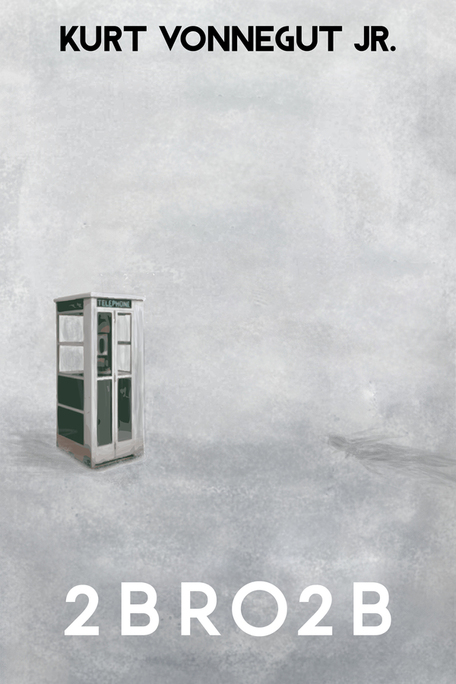
Deal Me in Challenge: 2BR02B by Kurt Vonnegut


Card Drawn: Ace of Clubs.

2BR02B. That is the question...

Is that not an awesome title or what? I couldn't have picked a better card from the deck to start the Deal Me in Challenge. Kurt Vonnegut is one of those authors that I have been meaning to read more from, especially since Slaughter-House Five is one of my favorite novels. He remains one of the best, if not the best, modern literary satirist of our time; an intelligent writer with a sardonic sense of humor and inimitable style whose caustic social commentary is thought-provoking as much as it is hilarious. I have always admired the talent of certain writers are able to write effective satire -- truth be told, not many come close to pulling it off with the sophistication and sharpness as Kurt Vonnegut. 

2BR02B would be classified as belonging to the dystopia science-fiction genre. The story takes place in the not so-distance future where population control is regulated by the state. There exist certain strict guidelines that must be followed concerning child-birth that involves...well, I've said enough already. Giving away the rest of the plot would ruin the fun of experiencing this wonderful story for yourself. Lately, I have been reading an exorbitant amount of short-stories to catch up with challenge (I'm currently 10 weeks behind, yikes!) and noticed several recurring patterns amongst a good portion of them: a sense of incompleteness, being abstract, haphazard, inchoate; essentially, they felt inconsequential. J.G. Ballard is a master of the short-story and he once said that "There have been plenty of perfect short-stories, but no perfect novels." He might be on to something there because 2BR02B is as close to a perfect short-story that I have ever come across. The novelist can get away with digressions, side-plots, elaborate descriptions or detailed exposition quite easily, but not the short-story writer. Crafted meticulously, Vonnegut doesn't fill the limited space with empty words; nothing is amiss or superfluous; he doesn't miss a beat. As always, his trademark wit and acerbic social critique hits all the right notes. However, it is the tightly wound story and stunning climax that left me in complete awe. What a brilliant ending! Many short stories seem disposable, like dime novels or pulp fiction. You read them once, get some kick out of it and then move on to the next one without dwelling much on it. 2BRo2B does not fall into that category and will linger in my mind for a long time to come.

Going back to that J.G. Ballard quote, it seems to be that great novels can be flawed because they have so much other story material to make up for their deficiencies whereas there is very little room for error when it comes to the short-story. The author must work within far more  rigid parameters, striving to be as concise as possible without compromising the integrity of the narrative. No easy task. Vonnegut somehow makes it look easy.

Thursday, 26 February 2015

Deal Me In Challenge 2015


I was actually planning on doing a short-story reading event in the near future but I'm glad to have discovered the Deal Me In Challenge hosted by Jay over at Bibliopholopolis through Cleo because it saves me from all the necessary leg-work required to host one. Besides, it's unlikely that many people would sign up anyways so this just saves me the headache of trying desperately to get people to join. Here are the challenge details:

What is the goal of the project?
To read 52 short stories in 2014 (that’s only one per week)

What do I need?
1) Access to at least fifty-two short stories (don’t own any short story collections or anthologies? See links to online resources below)
2) A deck of cards
3) An average of perhaps just thirty minutes of reading time each week


Where do I post* about my stories?
(*You don’t have to post about every single story, of course, but if you have something to say about the story you read any given week, your fellow participants would love to hear it.)
1) On your own blog or website if you have one (I will link to your post at the bottom of my weekly post. I currently plan to do my weekly post on Sundays)
2) if you don’t have a blog or website you may comment on my weekly post, sharing thoughts on your own story – or start one at WordPress or blogspot – it’s easy and free to create a basic blog.

How do I pick which stories to read?
(The 52 stories themselves are totally up to you.) Before you get start reading, come up with a roster of fifty-two stories (you can use any source) and assign each one to a playing card in a standard deck of cards. It can be fun to use different suits for different types of stories, but that is optional. Each “week,” (if you’re like me, you may occasionally fall a story or two behind) you draw a card at random from your deck and that is the story you will read. There are links to last year’s participants’ rosters here if you want to see some examples.

What if I don’t have time to read a story every single week?
Try one of the challenge variations noted below, the Fortnight (or “payday” if you prefer) version is one story every two weeks or the “Full Moon Fever” version with just thirteen stories read or selected on seeing each full moon…

How do I sign up?
Leave a comment below with your URL and I will link you. My first wrap-up post of the year (I post weekly, usually Sunday night or Monday morning) will include links to any new Deal Me In posts and a list of the participants with links to their roster of stories.
 
What is the purpose?
To have FUN and to be exposed to new authors and stories and maybe get in the habit of reading a short story a week. Isn’t that enough?

I obviously have a lot of catching up to do but that shouldn't be too difficult considering the focus will be on short-stories rather than novels. The most difficult task will be narrowing down my list to 52 short stories. The challenge allows for participants to tweak their lists if they see fit and I intend to do just that. I have many short-story collections sitting on my shelf but many of them are thick and contain a lot more than 52 stories to choose from. So, I've decided to designate the card suits to specific categories: Spades is my personalized anthology list. If I happen to draw a spades card, then I will choose a story from that collection at random. Clubs is for science-fiction, Hearts is for Canadian authors and Diamonds is random. Here is my reading list:

Spades: Anthologies

A - Philip K. Dick - The Complete Short Stories
2 - Ray Bradbury - The Stories of Ray Bradbury
3 - John Updike - The Collected Stories
4 - J.D. Salinger - Nine Stories
5 - F. Scott Fitzgerald - Babylon Revisited and Other Stories
6 - D.H. Lawrence - Selected Stories
7 - Dorothy Parker - Complete Stories
8 - J.G. Ballard - The Complete Stories
9 - Graham Greene - May We Borrow Your Husband + Other Stories
10 - John Cheever - The Stories of John Cheever
J - Theodore Sturgeon - The Complete Stories
Q - Katherine Mansfield - Selected Stories
K - Flannery O'Connor - Complete Stories

Clubs: Science Fiction

A - 2BR20B by Kurt Vonnegut
2 - Bloodchild by Octavia Butler
3 - Wang's Carpets by Greg Egan
4 - For a Breath I Tarry by Roger Zelazny
5 - Driftglass by Samuel R. Delany
6 - Mimsy Were the Borogroves by Lewis Padgett
7 - Adam and No Eve by Alfred Bester
8 - All You Zombies by Robert Heinlein
9 - Vintage Season by C.I. Moore
10 - Nekropolis by Maureen McHugh
J - Burning Chrome by William Gibson
Q - Baby, You Were Great! by Kate Wilhelm
K - The Nine Billion Names of God by Arthur C. Clarke

Hearts: Canadian

A - Ray by Guy Vanderhaeghe
2 - Rape Fantasies by Margaret Atwood
3 - The Collectors by Rohinton Mistry
4 - A Scarf by Carol Shields
5 - Voices Lost in Snow by Mavis Gallant
6 - Real Life Writes Real Bad by Timothy Findley
7 - Let Me Promise You by Morley Callaghan
8 - Vision by Alistair Macleod
9 - Borders by Thomas King
10 -The Road Past Altamont by Gabrielle Roy
J - Paper Shadows by Wayson Choy
Q - Alice Munro - The Turkey Season
K - Four Stations in his Circle by Austin Clarke

Diamonds: Random

A - The Shawl by Cynthia Ozick
2 - St. Lucy’s Home for Girls Raised by Wolves by Karen Russel
3 - Tenth of December by George Saunders
4 - The Drunkard by Frank O'Connor
5 - One of these Days by Gabriel García Márquez
6 - Super-Frog Saves Tokyo by Haruki Murakami
7 - The Passenger by Vladimir Nabokov
8 - Gooseberries by Anton Chekov
9 - Souls Belated by Edith Wharton
10 - Let the Old Dead make Room for the Young Dead by Milan Kundera
J - A Country Doctor by Franz Kafka
Q - Where Are You Going, Where Have You Been? by Joyce Carol Oates
K - The Pit and the Pendulum by Edgar Allen Poe