Showing posts with label Guy Gavriel Kay. Show all posts

Tuesday, 14 April 2015

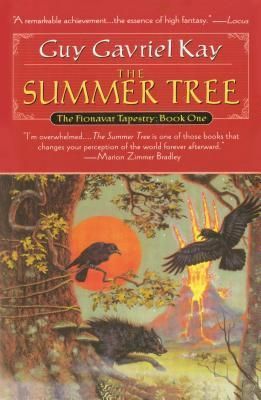
The Summer Tree (The Fionavar Tapestry #1) by Guy Gavriel Kay


“We salvage what we can, what truly matters to us, even at the gates of despair.”

Considering how much I adore the writings of Guy Gavriel Kay, it pains me to give his debut novel The Summer Tree a barely passing grade. It is hard to believe that this is the same author who penned such great novels like A Song for Arbonne, Tigana, and The Lions of Al-Rassan. Granted, a first novel rarely shows the author in top form; in most cases, they are still in the process of developing their craft, trying to figure out what they want to accomplish with their writing. This is the case here with The Summer Tree: Guy Gavriel Kay shows only glimpses of his superb talents that will become fully realized later on with his other novels. On the front cover of the Roc edition, Marion Zimmer Bradley praises The Summer Tree as "one of those books that changes your perception of the world forever afterward." This could not be a more hyperbolic and inaccurate statement--she was clearly paid a good deal of money to bestow such high praise upon a novel that is at best, a middling effort at high-fantasy and an innocuous homage to Tolkien. Luckily, the Fionavar Tapestry series was not my first exposure to Guy Gavriel Kay, otherwise it is unlikely that I would have picked up another one of his books.

While not a complete failure, the novel's main strength comes from Kay's exceptional world-building and detailed historical lore found in his imaginative universe of Fionavar. He shows early on of being able to create a vivid world with its unique mythology but it is the weak story and flat archetypal characters that really hurts this novel. As an epic narrative containing many interconnected story-lines and a huge cast of characters, Kay has difficulty balancing all of he different story elements and the end result is a bloated mess. If you are writing in the fantasy genre, the story has to be believable and make sense within its own governing logic. Unfortunately, Kay opts to either leave out key plot details or resorts to long-winded info-dumping where much of the story is a combination of dull and just plain baffling.

The basic premise is so poorly executed, which nearly ruined the entire story for me and other readers who are less forgiving are bound to be even more disconcerted: five students from the University of Toronto (glad to see my school and home town get some love) meet a wizard disguised as a guest speaker at a folklore conference who transports them to the magical realm of Fionavar. As outlandish and cliche as this scenario might be, I am willing to go along with it as long as there is a reasonable explanation. Sadly, Kay's set-up is half-baked and to make matters worse, when the five "chosen ones" get to this new world, there are no immediate protestations whatsoever. They all just shrug it off like it is no big deal to meet a wizard and his dwarf friend who can hurl them across the dimensions of time and space to a fantasy world where magic exists. Come on! At least show one of the characters in distress about their new circumstances, pleading to go home or questioning the Wizard's intentions for bringing them here in the first place. Nope. They just ease into their new roles without any sense of estrangement and soon find themselves entangled in a war against a "Dark Lord" that has awakened from a thousand year imprisonment underneath a mountain who is intent on destroying the land of Fionavar. It does not take long for the story to become silly and contrived with the familiar display of various genre tropes.

Despite these flaws, the story is entertaining enough if one is willing to disband all belief and accept Kay's premise. The Summer Tree is far from groundbreaking within the fantasy genre but one of its few redeeming qualities is Kay's elegant prose, which often contains a lyrical intensity and one gets the sense here that he is on the cusp of maturing into a great writer. The story boasts some interesting story-developments as well that best come through at the end but reaching these revelations is a real slog. It does seem as if Kay has a general idea of where the story is heading with the subsequent novels but whether or not he is capable of pulling it off by greatly improving on this novel remains to be determined. As a devoted fan of Guy Gavriel Kay, I will probably finish reading the series at some point but my expectations are extremely low.

On a side note: What's up with the some of the character names? One of the five friends who time-travels to Fionavar is named Paul Schafer. I kept picturing David Letterman's musical sidekick in the role. Oh, and the dwarf's name is Matt. Really? That is a human name, not a dwarf name. I thought you were well-read in the fantasy genre, Mr Kay! Even Rhioganedd Kinglyrock or Brannan Goldprospector would have been better.


Once Upon a Time IX

Wednesday, 25 February 2015

The Lions of Al-Rassan by Guy Gavriel Kay

“The deeds of men, as footprints in the desert. Nothing under the circling moons is fated to last. Even the sun goes down.” 

There are fantasy authors and then there is Guy Gavriel Kay who is in a league of his own. Not only does he deserve to be recognized as one of most talented writers of the genre but should also be regarded as one of Canada's finest writers. I mentioned this fact in my review of his other novel Tigana but it is worth reiterating once again. He often gets overlooked because his works are not taken seriously in contrast to his contemporaries such as Margaret Atwood, Michael Ondaatje or even more recent authors such as Joseph Boyden who tend to deal with "big issues" that reflect Canadian identity. Kay's novels may not be rooted in Canadian culture but they certainly cover a wide range of contentious issues such as religion (a major theme in The Lions of Al-Rassan), class, colonialism, gender, hegemony, power struggles, etc, so to simply say he only writes "entertaining fiction" would be a grave error in judgment. In fact, it is difficult to classify many of his novels, especially Lions, as a fantasy novel in the traditional sense because Kay is unorthodox in his methods, often playing around with genre conventions. It might be more accurate to label this particular work as some kind of hybrid of fantasy/historical fiction instead. 


The particular story is influenced by the history of Moorish Spain where Muslims, Jews and Christians were engaged in civil war. There are no fire breathing dragons, elves, dwarves, wizards or magic of any kind to be found here--only a beautifully written epic story about talented individuals who are forced to do extraordinary things because they live in a world on the verge of collapse and pure anarchy. Conflicting loyalties and religious ideologies create a a rift between friendships, family and love; the brutality of war dividing a nation into various factions, innocent blood spilled in the name of divine providence. While there are fight sequences and epic battle scenes, Kay doesn't indulge in grand gestures; rather, there is a poetic lyricism to the way he presents violence--much of the intense action occurring on the peripheral, a latent narrative strategy that effectively heightens the suspense leading up to those pivotal moments. The final confrontation between the two main characters who have been good friends up until this point and have now become leaders of opposing sides is handled with such precision, grace and unwavering intensity. The reader does not either of them to die in battle but of course, it is inevitable that only one shall triumph. For those who don't read a lot of fantasy or tend to avoid it on general principle, Guy Gavriel Kay is an author worth checking out who might just change your mind about the genre. As a master story-teller, his unique vision, memorable characters and sublime writing deserves nothing but the highest praise.

I only reserve 5-star ratings for masterful literary works that prove to be extra special in some way: The Lions of Al-Rassan easily falls into that select group (that now makes two 5-stars ratings for Mr. Kay so far, well done sir). In addition to containing everything that I look for in a novel--an absorbing story that is a pure joy to read with superb writing, well-drawn characters, having a breadth of ideas, possessing narrative cohesion that all leads up to a satisfactory climax--it is the emotional intensity and the achingly beautiful ending that really stand out. Kay's ability to create such sympathetic characters with depth and complexity is truly remarkable. They are never one dimensional and feel so real, coming to life right there on the page. Flawed, contradictory and perhaps not always acting with the most ethical conduct (heck, one of the main characters is an assassin), they uphold a sense of moral duty; even willing to die for for their beliefs, which makes them wholly unique individuals. Sorry if this sounds corny or cliche but I really cared passionately for these characters and on some level even grew to love them. I never expected to get so emotionally attached but as the story progressed towards its conclusion, I found myself completely entangled up in their lives and dreading what might become of their fate--the experience was almost unbearable. Kay surely knows how to pull on those heart-strings. This brings me to the climax of the novel, which hit me like a ton of bricks. Other than Virginia Woolf's To the Lighthouse, I don't ever recall being so profoundly moved by an ending. No, I didn't bawl my eyes out or anything that dramatic but I do admit to feeling a lump in my throat, choked up by the sheer beauty and magnitude of those final closing moments. An absolutely breathtaking and unforgettable novel.

On a final note, I  had the privilege of actually meeting Guy Gavriel Kay when he was doing a book signing here in Toronto last year. My first meet and greet with an author too. I don't get out much but this was an exception. The place even had live music and free food. Score! Mr. Kay was a very affable gentleman and we spoke briefly. Of course, I was completely awe-struck in his presence, sweating profusely, nervous as hell and tongue-tied the whole time during our brief conversation. Somehow I managed to tell him through all my stuttering that I loved his work and that they were sources of comfort during a recent rough period in my life. He was very humble, thanking me for being so honest and upfront with him. I then proceeded to ask whether or not he had ever been approached by Hollywood to adapt one of his novels but he wouldn't give me a direct answer. He played it coy, saying something along the lines of "Oh, I don't know..." and then gave me a wry smile before signing two of my books--one of which was The Lions of Al-Rassan (I can die happy now), the other being The Song of Arbonne. I would have liked him to have sign Tigana as well but there were others waiting in line and having nearly soiled myself in excitement, I needed to find a restroom quick time. It was such an honor to meet Guy Gavriel Kay and if he happens to be in town again for another one these book signing events or press tours, I'll be sure to attend and try acting less like a gushing fan-boy.


This novel also counts towards my Canadian Reading Project.