Showing posts with label Fantasy. Show all posts

Tuesday, 14 April 2015

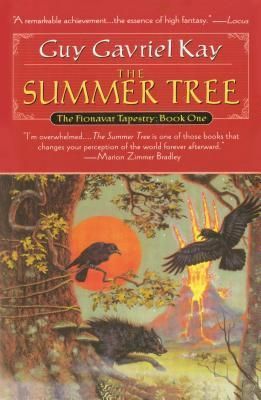
The Summer Tree (The Fionavar Tapestry #1) by Guy Gavriel Kay


“We salvage what we can, what truly matters to us, even at the gates of despair.”

Considering how much I adore the writings of Guy Gavriel Kay, it pains me to give his debut novel The Summer Tree a barely passing grade. It is hard to believe that this is the same author who penned such great novels like A Song for Arbonne, Tigana, and The Lions of Al-Rassan. Granted, a first novel rarely shows the author in top form; in most cases, they are still in the process of developing their craft, trying to figure out what they want to accomplish with their writing. This is the case here with The Summer Tree: Guy Gavriel Kay shows only glimpses of his superb talents that will become fully realized later on with his other novels. On the front cover of the Roc edition, Marion Zimmer Bradley praises The Summer Tree as "one of those books that changes your perception of the world forever afterward." This could not be a more hyperbolic and inaccurate statement--she was clearly paid a good deal of money to bestow such high praise upon a novel that is at best, a middling effort at high-fantasy and an innocuous homage to Tolkien. Luckily, the Fionavar Tapestry series was not my first exposure to Guy Gavriel Kay, otherwise it is unlikely that I would have picked up another one of his books.

While not a complete failure, the novel's main strength comes from Kay's exceptional world-building and detailed historical lore found in his imaginative universe of Fionavar. He shows early on of being able to create a vivid world with its unique mythology but it is the weak story and flat archetypal characters that really hurts this novel. As an epic narrative containing many interconnected story-lines and a huge cast of characters, Kay has difficulty balancing all of he different story elements and the end result is a bloated mess. If you are writing in the fantasy genre, the story has to be believable and make sense within its own governing logic. Unfortunately, Kay opts to either leave out key plot details or resorts to long-winded info-dumping where much of the story is a combination of dull and just plain baffling.

The basic premise is so poorly executed, which nearly ruined the entire story for me and other readers who are less forgiving are bound to be even more disconcerted: five students from the University of Toronto (glad to see my school and home town get some love) meet a wizard disguised as a guest speaker at a folklore conference who transports them to the magical realm of Fionavar. As outlandish and cliche as this scenario might be, I am willing to go along with it as long as there is a reasonable explanation. Sadly, Kay's set-up is half-baked and to make matters worse, when the five "chosen ones" get to this new world, there are no immediate protestations whatsoever. They all just shrug it off like it is no big deal to meet a wizard and his dwarf friend who can hurl them across the dimensions of time and space to a fantasy world where magic exists. Come on! At least show one of the characters in distress about their new circumstances, pleading to go home or questioning the Wizard's intentions for bringing them here in the first place. Nope. They just ease into their new roles without any sense of estrangement and soon find themselves entangled in a war against a "Dark Lord" that has awakened from a thousand year imprisonment underneath a mountain who is intent on destroying the land of Fionavar. It does not take long for the story to become silly and contrived with the familiar display of various genre tropes.

Despite these flaws, the story is entertaining enough if one is willing to disband all belief and accept Kay's premise. The Summer Tree is far from groundbreaking within the fantasy genre but one of its few redeeming qualities is Kay's elegant prose, which often contains a lyrical intensity and one gets the sense here that he is on the cusp of maturing into a great writer. The story boasts some interesting story-developments as well that best come through at the end but reaching these revelations is a real slog. It does seem as if Kay has a general idea of where the story is heading with the subsequent novels but whether or not he is capable of pulling it off by greatly improving on this novel remains to be determined. As a devoted fan of Guy Gavriel Kay, I will probably finish reading the series at some point but my expectations are extremely low.

On a side note: What's up with the some of the character names? One of the five friends who time-travels to Fionavar is named Paul Schafer. I kept picturing David Letterman's musical sidekick in the role. Oh, and the dwarf's name is Matt. Really? That is a human name, not a dwarf name. I thought you were well-read in the fantasy genre, Mr Kay! Even Rhioganedd Kinglyrock or Brannan Goldprospector would have been better.


Once Upon a Time IX

Wednesday, 25 February 2015

The Lions of Al-Rassan by Guy Gavriel Kay

“The deeds of men, as footprints in the desert. Nothing under the circling moons is fated to last. Even the sun goes down.” 

There are fantasy authors and then there is Guy Gavriel Kay who is in a league of his own. Not only does he deserve to be recognized as one of most talented writers of the genre but should also be regarded as one of Canada's finest writers. I mentioned this fact in my review of his other novel Tigana but it is worth reiterating once again. He often gets overlooked because his works are not taken seriously in contrast to his contemporaries such as Margaret Atwood, Michael Ondaatje or even more recent authors such as Joseph Boyden who tend to deal with "big issues" that reflect Canadian identity. Kay's novels may not be rooted in Canadian culture but they certainly cover a wide range of contentious issues such as religion (a major theme in The Lions of Al-Rassan), class, colonialism, gender, hegemony, power struggles, etc, so to simply say he only writes "entertaining fiction" would be a grave error in judgment. In fact, it is difficult to classify many of his novels, especially Lions, as a fantasy novel in the traditional sense because Kay is unorthodox in his methods, often playing around with genre conventions. It might be more accurate to label this particular work as some kind of hybrid of fantasy/historical fiction instead. 


The particular story is influenced by the history of Moorish Spain where Muslims, Jews and Christians were engaged in civil war. There are no fire breathing dragons, elves, dwarves, wizards or magic of any kind to be found here--only a beautifully written epic story about talented individuals who are forced to do extraordinary things because they live in a world on the verge of collapse and pure anarchy. Conflicting loyalties and religious ideologies create a a rift between friendships, family and love; the brutality of war dividing a nation into various factions, innocent blood spilled in the name of divine providence. While there are fight sequences and epic battle scenes, Kay doesn't indulge in grand gestures; rather, there is a poetic lyricism to the way he presents violence--much of the intense action occurring on the peripheral, a latent narrative strategy that effectively heightens the suspense leading up to those pivotal moments. The final confrontation between the two main characters who have been good friends up until this point and have now become leaders of opposing sides is handled with such precision, grace and unwavering intensity. The reader does not either of them to die in battle but of course, it is inevitable that only one shall triumph. For those who don't read a lot of fantasy or tend to avoid it on general principle, Guy Gavriel Kay is an author worth checking out who might just change your mind about the genre. As a master story-teller, his unique vision, memorable characters and sublime writing deserves nothing but the highest praise.

I only reserve 5-star ratings for masterful literary works that prove to be extra special in some way: The Lions of Al-Rassan easily falls into that select group (that now makes two 5-stars ratings for Mr. Kay so far, well done sir). In addition to containing everything that I look for in a novel--an absorbing story that is a pure joy to read with superb writing, well-drawn characters, having a breadth of ideas, possessing narrative cohesion that all leads up to a satisfactory climax--it is the emotional intensity and the achingly beautiful ending that really stand out. Kay's ability to create such sympathetic characters with depth and complexity is truly remarkable. They are never one dimensional and feel so real, coming to life right there on the page. Flawed, contradictory and perhaps not always acting with the most ethical conduct (heck, one of the main characters is an assassin), they uphold a sense of moral duty; even willing to die for for their beliefs, which makes them wholly unique individuals. Sorry if this sounds corny or cliche but I really cared passionately for these characters and on some level even grew to love them. I never expected to get so emotionally attached but as the story progressed towards its conclusion, I found myself completely entangled up in their lives and dreading what might become of their fate--the experience was almost unbearable. Kay surely knows how to pull on those heart-strings. This brings me to the climax of the novel, which hit me like a ton of bricks. Other than Virginia Woolf's To the Lighthouse, I don't ever recall being so profoundly moved by an ending. No, I didn't bawl my eyes out or anything that dramatic but I do admit to feeling a lump in my throat, choked up by the sheer beauty and magnitude of those final closing moments. An absolutely breathtaking and unforgettable novel.

On a final note, I  had the privilege of actually meeting Guy Gavriel Kay when he was doing a book signing here in Toronto last year. My first meet and greet with an author too. I don't get out much but this was an exception. The place even had live music and free food. Score! Mr. Kay was a very affable gentleman and we spoke briefly. Of course, I was completely awe-struck in his presence, sweating profusely, nervous as hell and tongue-tied the whole time during our brief conversation. Somehow I managed to tell him through all my stuttering that I loved his work and that they were sources of comfort during a recent rough period in my life. He was very humble, thanking me for being so honest and upfront with him. I then proceeded to ask whether or not he had ever been approached by Hollywood to adapt one of his novels but he wouldn't give me a direct answer. He played it coy, saying something along the lines of "Oh, I don't know..." and then gave me a wry smile before signing two of my books--one of which was The Lions of Al-Rassan (I can die happy now), the other being The Song of Arbonne. I would have liked him to have sign Tigana as well but there were others waiting in line and having nearly soiled myself in excitement, I needed to find a restroom quick time. It was such an honor to meet Guy Gavriel Kay and if he happens to be in town again for another one these book signing events or press tours, I'll be sure to attend and try acting less like a gushing fan-boy.


This novel also counts towards my Canadian Reading Project.

Friday, 20 February 2015

Mini Reviews #2: Mistborn - The Final Empire, Valis, The Brief Wondrous Life of Oscar Wao.

Having been away for a prolonged period of time, it's time to play catch-up again with some more mini-reviews. Round two.


Mistborn: The Final Empire (Mistborn #1) by Brandon Sanderson


Here I am embarking on another epic fantasy series after swearing to myself that I would avoid them after several disappointing encounters with other works in the genre. However, the first novel of the Mistborn series proved to be surprisingly entertaining with a well-conceived world and characters that don't fall into typical fantasy cliches. They are flawed and contain a lot more depth in contrast to the usual fanfare. Sanderson proves to be a very capable writer and he can certainly spin a good story full of intrigue, suspense and action but with this novel he seems to be setting the stage for the rest of the series so it feels underwhelming as a whole. I wanted more. I suppose that means the author should be complimented for writing a compelling enough story to keep me interested.
 

I also want to note that the magical system he creates here is probably one of the best I have ever come across in a fantasy novel albeit, slightly confusing at first. Even though Sanderson doesn't bring anything new to the genre in terms of story (a ragtag group of rebels plan to overthrow a Dark Lord, sound familiar?) I am still curious to see where he goes from here with the next two novels in the series. The best part of the novel for me is the final few chapters which builds up nicely to an explosive finale revealing a lot of key components that opens up the story to countless possibilities. This gives me hope that Sanderson knows what he is doing and actually has a clear idea of where the story is heading instead of other authors who tend to have no clear resolution in sight and just drag the series along. That's right, I'm looking at you Robert Jordan and George R.R. Martin. 


Valis by Philip K. Dick


This novel is insane and only the brilliant mind of Philip K. Dick could have written it. Semi-autobiographical, hallucinogenic and overflowing with ideas, the story follows Dick's alter-go named Horselover Fat (Philip in Greek translates to "fond of horses" and Dick in German is "Fat") who believes that he has been touched by the hand of God or some kind of supreme being through a beam of a light that enters his brain. He embarks on a theological quest to seek the "truth" but of course, he is seen by others as a crazy person. Or maybe he is the one who is sane and everyone else is crazy. For those out there who think that science-fiction is cheesy or has nothing significant to offer, look no further than Philip K. Dick to shatter those preconceived notions. Like several of his other novels, this one is far from perfect, containing various flaws in terms of plot development and a lackluster ending but Philip K. Dick has never been renowned for his story-telling abilities. First and foremost he is a philosopher, a man of ideas. Philip K. Dick is one of those special writers dear to my heart. He possesses such a wild and creative imagination and always leaves the reader contemplating the BIG questions of existence, reality and the universe: Valis is unlike anything I have ever read before and there has been nothing ever written like it since.


 The Brief Wondrous Life of Oscar Wao by Junot Diaz


I seem to be in the minority here but I absolutely adored this novel. Winner of the Pulitzer prize in 2008, Junot Diaz came out of the nowhere to snatch the coveted prize much to the disbelief and outrage of the literary world. I'm not one to follow these prestigious book awards but I think the committee might have made the correct choice for once. Granted, Diaz's novel isn't groundbreaking by any stretch of the imagination but he has a unique voice, writes beautifully even when using excessive profanity (no small accomplishment) but above all, he packs such raw emotion into the story and characters. You can tell that he really loves his characters, which makes it easy to sympathize with them even though they aren't exactly the most honorable or likable individuals. The title is meant to be facetious because the protagonist's life really isn't all that wondrous--in fact, its actually quite ordinary without a happy ending, full of  sadness and heartbreak. Oscar Wao is a character that I can personally relate to, which helps to explain why this novel resonated with me on a such deep level: he's a book nerd who loves Star Wars and fantasy, shy, introverted,  an outsider, socially awkward, hopeless when it comes to women. Hey, Mr. Diaz, are you sure you didn't happen to base Oscar on me? 

Anyways, the story also doesn't just focus on Oscar himself but contains several flashbacks of his different family members living in the Dominican Republic (his mother, grandfather) and the narrative moves towards the present day when the Wao's eventually immigrate to America. At one point, Oscar's cousin even becomes a narrative voice. This now brings us to the footnotes. You see, not only is the author interested in telling his story, he also wants to provide a history lesson at the same time. Many people are bound to be annoyed by the long, detailed notes that provide a historical background concerning the tumultuous social and political landscape of the Dominican Republic as it transitioned from corrupt fascism to democracy but I actually found it quite informative. Diaz also uses playful rhetoric and humor as well within these footnotes so it's not as if one is being forced to endure a dry and tedious lecture. Furthermore, Diaz manages to touch upon some very important issues such as social displacement, the diaspora, racism, religion, cultural barriers, even the conflicts that arise with generation gaps. Funny, intelligently written, poignant. Diaz has a bright future ahead of him and I can't wait to see what he comes up with next. Don't let the hype get to you, this is a great novel that stands tall on its own merits.

Tuesday, 17 February 2015

Theft of Swords by Michael J. Sullivan


“I like any plan where I don’t die a horrible death.”

Never judge a book by its cover right? Well, guilty as charged. I don't really read a lot of fantasy novels and Michael J. Sullivan's Theft of Swords -- the first volume of the Riyria Revelations -- reminds me why this tends to be the case. Sloppy writing, overflowing with cliches, plot holes galore and a knack for excessive info dumping. What happened to a little subtlety? Split into two novels, the story revolves around two expert thieves and their adventures as they are hired to steal back two different swords. They get dragged into the political turmoil of the land, meet a bunch of different characters along the way who help them on their journey, find themselves in sticky situations where they have to rely on their skills and wit to escape, encounter treacherous villains, get into lots of swords fights, hook up with some Wizard and at one point even do battle with an ancient flying basilisk. Sounds exciting right? Well, not really. It's all sorta dull. The premise is decent enough and the story actually starts off great but it goes quickly downhill from there. There were so many parts that left me scratching my head in confusion or disbelief. If you are working within the fantasy genre, it is imperative for the author to make sure that the world and story they create is believable. Unfortunately for Sullivan, none of it makes a whole lot of sense.

Sorry if it sounds harsh, but this novel comes across as amateur fan-fiction. I'm probably being overly generous in giving it two stars when it probably deserves much less. I don't give out half-stars but if I did, 1.5 sounds about right. See, the first section isn't completely terrible and captured my interest just enough to keep me reading but the second part is where the novel really suffers. During my recovery in hospital, I was looking for something light and entertaining at the time. With such a cool-looking cover and after reading a brief synopsis, Theft of Swords seemed most promising. Unfortunately, my instincts were wrong again and despite the novel's numerous flaws, I still somehow managed to finish it. Don't ask me how, it must have been the meds I was on that messed up the synapses in my brain. Anyways, the story has potential and I was hoping that it would develop into something worthwhile but instead it left me thoroughly frustrated with its inconsistencies--the slapdash narrative, uneven pacing and shoddy world-building being the most glaring negative aspects. I couldn't help but feel that the author was making up the story as he went along without any clear sense of where the actual narrative was heading and unsure of how to reach a proper conclusion.
Leaving out key plot details either through incompetence or as a narrative strategy to create suspense or intrigue  is ineffective here because Sullivan is not a skilled enough writer so the story ends up floundering in no-man's land. Not once did I ever get a clear picture of this particular world, its inhabitants, various regions or places (The wizard's prison comes to mind. What the hell was that?) It's all a jumbled mess that is barely comprehensible. The two main characters are interesting enough and share good chemistry but it's a shame that every other aspect of the story falls flat. They are supposed to be expert thieves, capable of coming up with expert plans but the solution to every problem seemed so predictable. In fact, most of the story is silly and predictable.

Then again, there are still several more novels in the series so hopefully I am wrong in my current assessment. Perhaps the author manages to do a complete 360: fleshing out the story and characters and then somehow tying everything together with coherent narrative. Suffice it to say, I have my doubts. Had I read this novel under different circumstances, I would have abandoned it sooner instead of forcing myself to wad through 600+ pages of mediocrity. It is highly unlikely that I will continue with the series but if I'm ever scrambling to find something to read while on the toilet, The Riyria Revelations might prove to be most convenient.

Monday, 8 September 2014

Tigana by Guy Gavriel Kay


"In this world, where we find ourselves, we need compassion more than anything, I think, or we are all alone.”

Stop the press! I hereby declare that Tigana may just be the finest stand-alone fantasy novel ever written. Yeah, it's that good. In fact, it transcends the genre and should be recognized as a great piece of literature in its own right. This is my my first encounter with the writings of Guy Gavriel Kay and it certainly won't be the last. Where has this author been hiding all my life? I'm kicking myself for not having read anything by him sooner. He's even Canadian! Shame on me.

I am not sure how his other novels compare, but based solely on the masterful work that is Tigana, it's a travesty that Mr. Kay has not received the recognition so rightfully deserved as one of the great Canadian authors of our time. Sure, he is much praised within fantasy circles, but rarely is he ever acknowledged amongst the more notable Canadian writers such as Margaret Atwood, Mordecai Richler, Michael Ondaatje, Robertson Davies, W.O. Mitchell or Alice Munro (just to name a few) who tend to steal the spotlight. I can't seem to shake off the nagging feeling that he has been wrongfully excluded because of a certain level of prejudice that exists against authors who write within the fantasy genre. This elitist attitude is completely unsound and downright infuriating to me. I really wish people would keep more of an open mind, embracing literature in its many forms instead of being quick to judge a novel as simply derivative just because it does not fall into the general consensus of serious literature.

So what is this story about? Well, for starters, it revolves around a conquered land known as the Palm, whose territory is divided up by two opposing empires, each under the control by a powerful sorcerer--Brandin of Ygrath of Alberico of Barbidor. For over twenty years, peace has been maintained by the two rulers but now tensions are beginning to rise as certain events are set into motion by a small group of rebels who aim to overthrow their oppressors. One particular province named Tigana has been cursed by Brandin due to particular circumstances and will soon pass out of all knowledge unless these individuals find a way to bring its name back into the world. Kay weaves a rich history of culture and religion that is nothing short of mesmerizing. He transports the reader to a fantastic realm that pulsates with authenticity and there is no limit to his imagination. It would be cruel to reveal more plot details and spoil the fun of discovering them on your own but it should be noted that the novel is surprisingly light on fantasy elements, the main emphasis placed on the characters and story. There is very little action, no large battles until the very end and the display of magic is marginal. Kay's decision to scale back the action is well-conceived because it allows more time to focus on the intricate narrative rather than wasting time on pointless fighting sequences. When these small bursts of action do occur, the stage has been slowly set up for awesomeness. One of the many interesting aspects of the novel is that the magic used in this world remains ambiguous and Kay is not adamant to go into technical detail at all. This approach is surprisingly effective, leaving room for the reader to use their imagination, to infer through context. He is a natural born story-teller, a very skilled writer who knows how to cleverly hook the reader into the narrative by revealing just enough information but not leaving them completely in the dark; dropping clues, calmly building suspense, and then knowing exactly when to divulge key plot points that are stunning in their turning points to move the story along towards its spectacular finale. He makes it seem so effortless.

Kay is able to take those familiar fantasy genre tropes and flip them on their head to tell a story that is truly unique full of depth and complexity. He imbues layers of ambiguity, metaphors and subtext that leaves the reader with plenty to contemplate. In fact, one can argue that the novel serves as a parable or allegory of colonial rule, the loss of cultural identity that often afflicts a conquered people. Tigana is a slow-burn and somewhat confusing at first since Kay drops the reader into this fantastical world without very little explanation, not to mention the plethora of characters to keep track of. Considering the many interconnected story-lines, Kay performs a miraculous juggling act with the use of shifting narrative perspectives to keep the story flowing at a steady pace. There are plenty of surprises and unexpected plot twists that dropped my jaw to the floor. As a stand-alone epic, I didn't think Kay could successfully pull it off without stumbling towards a lackluster climax but he continually surprised me and left me in awe. The penguin edition clocks in close to 800 pages and it's usually the sign of a great novel if it manages to keep me turning the pages at a brisk pace and by its conclusion, leave me wanting more. I honestly can't remember the last time I became so enraptured by a novel, reveling in the absolute pleasure of reading a great story that is entertaining as much as it is intelligently written, filled with elegant prose and memorable characters--heroes and villains that are not portrayed in black-and-white but come across as complex individuals struggling with their consciousness and who undergo moral dilemmas as a result of their actions. Kay also writes compelling female characters, strong independent women who do not fall into stereotypical gender roles. There are a few sex scenes (gasp!) but they are not gratuitous and believe it or not, actually serve a purpose to the story. Although it is difficult for me to settle upon a favorite character, Brandin of Ygrath stands out as one of the more fascinating villains I have come across in fantasy. He is a tyrant and has committed unspeakable crimes but he is a sympathetic antagonist whose cruel actions are understandable considering the circumstances leading up to his victory over the Western Palm. He might be a sorcerer wielding great power, but he is also human, someone who is flawed, blindsided by grief but also capable of expressing love, especially towards Dianora who plays a key role in the story.
  
On a somewhat related note, it surprises that no movie studios have decided to buy the rights to this novel. Kay's writing possesses a very cinematic quality that would translate well to the silver-screen and the epic story would certainly appeal to a mass audience but then again, it would also be very difficult to do the novel justice. Perhaps a mini-series would be the better way to go. This is one of those rare novels that still lingers in my mind and I can't wait to revisit it again. Even if you aren't a fan of the fantasy, do yourself a favor and give Tigana a chance. Like me, you might be pleasantly surprised to discover a newfound appreciation of the genre.


This novel is part of my Canadian Reading Project.