Showing posts with label Review. Show all posts

Tuesday, 14 April 2015

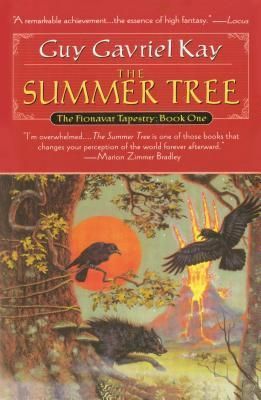
The Summer Tree (The Fionavar Tapestry #1) by Guy Gavriel Kay


“We salvage what we can, what truly matters to us, even at the gates of despair.”

Considering how much I adore the writings of Guy Gavriel Kay, it pains me to give his debut novel The Summer Tree a barely passing grade. It is hard to believe that this is the same author who penned such great novels like A Song for Arbonne, Tigana, and The Lions of Al-Rassan. Granted, a first novel rarely shows the author in top form; in most cases, they are still in the process of developing their craft, trying to figure out what they want to accomplish with their writing. This is the case here with The Summer Tree: Guy Gavriel Kay shows only glimpses of his superb talents that will become fully realized later on with his other novels. On the front cover of the Roc edition, Marion Zimmer Bradley praises The Summer Tree as "one of those books that changes your perception of the world forever afterward." This could not be a more hyperbolic and inaccurate statement--she was clearly paid a good deal of money to bestow such high praise upon a novel that is at best, a middling effort at high-fantasy and an innocuous homage to Tolkien. Luckily, the Fionavar Tapestry series was not my first exposure to Guy Gavriel Kay, otherwise it is unlikely that I would have picked up another one of his books.

While not a complete failure, the novel's main strength comes from Kay's exceptional world-building and detailed historical lore found in his imaginative universe of Fionavar. He shows early on of being able to create a vivid world with its unique mythology but it is the weak story and flat archetypal characters that really hurts this novel. As an epic narrative containing many interconnected story-lines and a huge cast of characters, Kay has difficulty balancing all of he different story elements and the end result is a bloated mess. If you are writing in the fantasy genre, the story has to be believable and make sense within its own governing logic. Unfortunately, Kay opts to either leave out key plot details or resorts to long-winded info-dumping where much of the story is a combination of dull and just plain baffling.

The basic premise is so poorly executed, which nearly ruined the entire story for me and other readers who are less forgiving are bound to be even more disconcerted: five students from the University of Toronto (glad to see my school and home town get some love) meet a wizard disguised as a guest speaker at a folklore conference who transports them to the magical realm of Fionavar. As outlandish and cliche as this scenario might be, I am willing to go along with it as long as there is a reasonable explanation. Sadly, Kay's set-up is half-baked and to make matters worse, when the five "chosen ones" get to this new world, there are no immediate protestations whatsoever. They all just shrug it off like it is no big deal to meet a wizard and his dwarf friend who can hurl them across the dimensions of time and space to a fantasy world where magic exists. Come on! At least show one of the characters in distress about their new circumstances, pleading to go home or questioning the Wizard's intentions for bringing them here in the first place. Nope. They just ease into their new roles without any sense of estrangement and soon find themselves entangled in a war against a "Dark Lord" that has awakened from a thousand year imprisonment underneath a mountain who is intent on destroying the land of Fionavar. It does not take long for the story to become silly and contrived with the familiar display of various genre tropes.

Despite these flaws, the story is entertaining enough if one is willing to disband all belief and accept Kay's premise. The Summer Tree is far from groundbreaking within the fantasy genre but one of its few redeeming qualities is Kay's elegant prose, which often contains a lyrical intensity and one gets the sense here that he is on the cusp of maturing into a great writer. The story boasts some interesting story-developments as well that best come through at the end but reaching these revelations is a real slog. It does seem as if Kay has a general idea of where the story is heading with the subsequent novels but whether or not he is capable of pulling it off by greatly improving on this novel remains to be determined. As a devoted fan of Guy Gavriel Kay, I will probably finish reading the series at some point but my expectations are extremely low.

On a side note: What's up with the some of the character names? One of the five friends who time-travels to Fionavar is named Paul Schafer. I kept picturing David Letterman's musical sidekick in the role. Oh, and the dwarf's name is Matt. Really? That is a human name, not a dwarf name. I thought you were well-read in the fantasy genre, Mr Kay! Even Rhioganedd Kinglyrock or Brannan Goldprospector would have been better.


Once Upon a Time IX

Wednesday, 11 March 2015

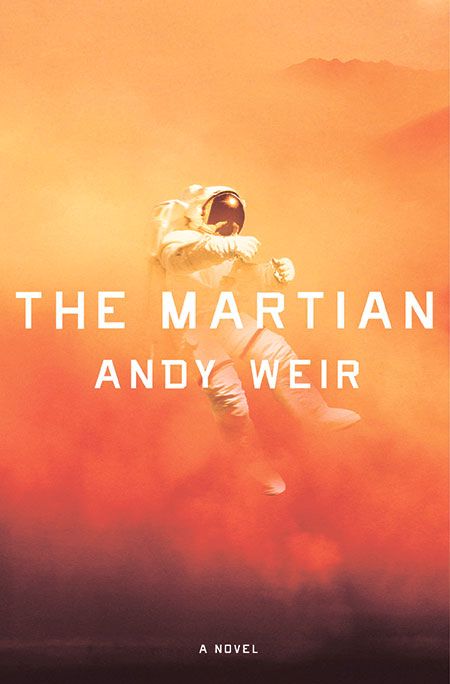
The Martian by Andy Weir


“It’s true, you know. In space, no one can hear you scream like a little girl.” 

Andy Weir's The Martian has received a lot of buzz since its release, generating a media-circus of attention, making best-sellers lists and highly praised by many readers. Whenever a book garners this much hype and attention, I tend to remain skeptical concerning it's true merit. So, I kept this novel on my radar, unwilling to conform to the general reading public, since everyone and their grandmother seemed to own a copy. As an unabashed science-fiction geek, I was still mildly interested in what all the hoopla was about but remained convinced that with such high expectations, it  the novel would more than likely turn out to be a huge disappointment. Nonetheless, curiosity got the better of me when it was announced that Hollywood was planning a movie adaptation starring Matt Damon, a bunch of other great actors and directed by Ridley Scott. I may not be the biggest Matt Damon fan but having Ridley Scott attached to the project was enough for me to finally break down and give into peer pressure. This is the guy who directed such science-fiction masterpieces like Alien and Blade-Runner! Plus, he's getting up there in age and if he was willing to come out of semi-retirement to bring this novel to life on the big screen, he must have seen something special and worthwhile in it.

Well, what do you know...Ridley Scott recognizes another great story containing cinematic qualities that should be suited to his particular style of film-making. If Alien is any indication, this is a director who has a great visual sense and knows exactly how to create a dreadful atmosphere of thrilling suspense within a confined setting. He is perfect for the job because The Martian caters to his artistic sensibilities: a story about an astronaut named Mark Watney, who finds himself stranded on Mars due to a freak accident that occurs during a surveying mission, left behind by his crew because they think he is dead. With no one else to rely on but himself, Watney must use his wits, skills, engineering training and scientific knowledge to survive. Limited supplies, short on food, unable to communicate with NASA, he finds himself all alone on the red planet. If the harsh environment of Mars doesn't kill him first, starving to death surely will. The comparison to Defoe's Robinson Crusoe seems inevitable but Weir's novel does not have a socio-political agenda, nor does he dabble in allegory--his main intention here is to tell an absorbing piece of science-fiction, which he definitely delivers. The narrative is written largely as an epistolary, taking on the form of journal entries by Mark Watney who documents his day-to-day activities on Mars, which largely include brainstorming survival strategies, performing risky experiments and dealing with life-threatening catastrophes. He also spends an exorbitant amount of time watching re-runs of 70's sitcoms that were left by one of the other crew members and listening to disco music that drives him up the wall. How else is a  guy supposed to unwind after spending an exhausting day alone on a planet that is trying to constantly kill him, without access to Netflix? Weir also presents a third person narration, providing different perspectives of members working at NASA who discover Mark is still alive and now must try and figure out a way to bring him home. By cutting back and forth between Watney's personal account of his exploits on mars and with NASA, keeps the story from becoming too solipsistic, adding another dimension to the narrative arc.

Watney's self-deprecating personality is refreshing, often creating moments of comedic relief, which help to counterbalance the more serious elements of the novel. He realizes that his chances of survival are slim and that death is imminent, but he manages to maintain a wry sense of amusement about the whole situation. I hope the film adaptation manages to keep the humor of the novel intact.

The amount of scientific research that must have went into this novel is astonishing. Even though it takes on certain characteristics of hardcore-science fiction where the author bombards the reader with technical details, relying heavily upon math, physics and chemistry as a narrative device (all subjects that gave me the most trouble in school), the novel still remains accessible. It is not important to fully understand the exact science being described, since Weir does an admirable job of conveying the primary essence of these scientifc technicalities. Who would have thought that reading about potato farming on Mars could be so interesting?

I am glad to report that my initial assumptions were wrong and The Martian is well deserving of its favorable prestige. Having read my fair share of science-fiction that take place on Mars--Ray Bradbury's Martian Chronicles and Kim Stanley Robinson's Mars Trilogy come to mind--Andy Weir puts a unique spin on the colonization of a distant planet story-line, proving himself to be a capable writer who succeeds in telling a highly entertaining story, holding me in suspense and gripping my attention until the very last page.


Monday, 9 March 2015

Crime and Punishment by Fyodor Dostoevsky


“Taking a new step, uttering a new word, is what people fear most.”

I have been meaning to write a review of Dostoevsky's masterful Crime and Punishment for ages but kept putting it off for mainly two reasons: 1) procrastination. 2)  my ineptitude at tackling such a complex novel. Now over two years have gone by and still I find myself in the exact same situation, struggling to come up with anything that might constitute a half-decent review that would do this novel justice. Then it dawned on me: I've been going about this all wrong. For the sake of posterity, this quintessential Russian classic has mesmerized readers for generations, firmly establishing its status as one of the greatest novels ever written. Thus, it would be an exercise in futility for me to attempt any sort of critical analysis that might shed some light on a particular aspect of the text that has yet to be recognized, since, an interminable amount of scholarly research has already been expended in that area. I could elaborate on the many ideas and various plots found in this thematically rich novel but that would be redundant as well. Therefore, it seems prudent to not focus on writing an elaborate essay but rather, present a less 'formal' review; one that is more delegated towards personal opinion. I can handle that.

First off, Crime and Punishment stands as one of the best novels I have ever read. Insert any number of superlatives here that typically follow such praise bestowed upon a literary work: powerful, brilliant, mind-blowing, beautiful, a work of genius! Indeed, all of these labels of approbation would apply. Second, as far as psychological character studies go, it is difficult to top Dostoevsky here. I have always found anti-heroes to be far more compelling; ones who battle their own personal demons, present an ethical conundrum, undergo an internal struggle as a means to rationalize their immoral behavior. The protagonist, Rodion Romanovich Raskolnikov (those Russian names sure are long and difficult to pronounce), is fascinating in this regard because even though he is despicable for having committed multiple murders (not a spoiler, the plot is well known), Dostoevsky manages to create sympathy towards him with great skill; or at least, make the reader question Raskolnikov's morality by exploring his troubled consciousness. As a rationalist, he attempts to justify murder but is driven to delirium, paranoia, even madness. His psychological turmoil is conveyed with such a striking intensity that is often exhausting on the part of the reader because the story is told primarily from Raskolnikov's point of view; thus, given direct access to his mind, we as readers, are placed in his shoes -- his suffering becomes our own. Raskolnikov struggles with the unspeakable evil of his crimes and there are plenty of religious ideas bouncing around but salvation does not come easy for him. 

On a final note, this brings us to the epilogue, which in turn, tends to be quite divisive amongst readers. Some will argue that it feels incongruous with the rest of the novel because of the dramatic shift in tone from nihilistic despair to hopeful optimism, emphasized by the ostensibly preposterous 'love conquers all' scenario. However, taking a closer look at the epilogue, I do not believe Dostoevsky's intentions were to show romantic love as the primary source for Raskolnikov's redemption, but more-so, the losing of himself in another person. Maybe I'm just a hopeless romantic and perhaps it does sound cheesy, but that does not make it any less true, at least from my own philosophical outlook. Prior to this pivotal moment, Raskolnikov was trapped within his own existential crisis, a prisoner of his own mind, living in a perpetual state of limbo. Lonely and depressed, he murders to release all of the frustration, inner strife and self-hatred plaguing his mind. This ennui and passivity is finally transformed into action. The pawnbroker just happens to be at the wrong place at the wrong time. Love can be inspiring, a powerful motivator and for the lucky ones, a reason to live. It's human nature to love and want to be loved. 

My initial apprehension in reading Crime and Punishment was largely based on the fact that it is a Russian text and I had a lot of difficulty deciding which translation would be most preferable. Rest assured, I do not harbor any xenophobic tendencies but there is no denying my predilection towards English-written literary works. I did a lot of snooping around the Internet, even posted on message boards asking others who were more familiar with the works of Dostoevsky, which versions they preferred -- all in the attempt to figure out which translations were considered the most 'accurate' in terms of keeping the original authorial voice intact. Unfortunately, I was unable to discover any general consensus on the issue. The most common response to my question was that it all came down to personal preference. Nonetheless, two big names did stand out though (well, technically three): Constance Garnett vs. the duo of Richard Pevear and Larissa Volokhonsky. Garnett was one of the first translators of Russian texts into English while Pevear and Volokhonsky have gained international fame for their more recent translations. After much debate, I finally chose to go with the latter. As someone who is not fluent in Russian, I have no idea whether or not their version holds sway over the others. Translations are a fickle business; they can never be perfect. Every language has its own unique linguistics with various syntax, semantics, phonetics, speech patterns etc. I'm no linguistics expert but reading Shakespeare in Chinese will obviously be interpreted completely different; the stresses in the lines in disarray; many of the subtle nuances in the language lost or non-existent. Furthermore, the translator always brings a certain level of bias towards any given text, even on a subconscious level. Their interpretation of the author's meaning may be slightly altered by their own personal views or perspectives on various issues; perhaps certain words or phrases of one language don't exist in the other, so they have to decide on the most viable substitutions. Once again, bias. 

Regardless of all these complications, I still think Richard Pevear and Larissa Volokhonsky did an excellent job with their translation of Crime and Punishment because as far as I can tell, the emotional nuances were not compromised. The protagonist's agony and mental distress is palpable; the intense feeling of dread and hopelessness conveyed with unflagging fervor. For those who might be intimidated by the great Russian writers like Dostoevsky, cast aside your fears and take the plunge. Like myself, you might happen to discover a whole new world of literature to explore. The Russians can be a temperamental bunch, that's for sure. But if you like your novels dark and brooding, full of penetrating existentialist and religious discourse, look no further than the Mr. Dostoevsky to deliver the goods. Crime and Punishment would be a perfect place to start.


This novel is part of my Classics Club Challenge.

Thursday, 5 March 2015

Another Country by James Baldwin


“We all commit our crimes. The thing is to not lie about them -- to try to understand what you have done, why you have done it. That way, you can begin to forgive yourself. That's very important. If you don't forgive yourself you'll never be able to forgive anybody else and you'll go on committing the same crimes forever.” 

An astonishing contrast exists Richard Wright's Native Son and Jame's Baldwin Another Country. While both authors attempt to reconcile their socio-political beliefs as African- Americans and artistic vision as writers, their ideologies and aesthetic approach could not be more different. Richard Wright is a polemical writer; he's far more radical, expressing a lot of anger is his novel towards the dominant white society for the racial discrimination against blacks and less optimistic about social change without violent retaliation. In comparison, Baldwin preaches peace and love (perhaps living during the 60's and adopting a bohemian life style contributed to his philosophical outlook); he is more inclined to believe that not only blacks, but all minorities, should and will achieve equal rights and freedoms by co-operation and establishing grass-roots movements, not through violent measures. 

Richard Wright would likely denounce Baldwin as a coward and an idealist; someone living in a fantasy. Baldwin's rejoinder would be that Richard Wright compromises his artistic integrity for the sake of propaganda. Their confrontation would start to get really heated; vituperative remarks would pass back and forth but it is Wright who decides to throw the first punch. However, Baldwin is a diminutive giant, and with quick reflexes he dodges the left hook with relative ease. Wright is now fuming and frustrated with himself. He clearly underestimated this Baldwin fellow, who even as a heavy smoker, still manages to move around swiftly with plenty of endurance. He is going to need help if he has any chance of taking down his opponent, so he calls up his buddy Malcolm X who shows up almost immediately. Baldwin's confidence now begins to dwindle but even outnumbered, he has too much pride to back down. I'm a lover, not a fighter, he continues to tell himself. This is a losing battle so his only option is to run but doesn't get very far before being cornered. All hope seems to be lost and he is about to receive the beating of a life-time when all of a sudden, Martin Luther King swoops in right in the knock of time to save his friend! Dr. King is the voice of reason and he settles everyone down. He tells them that they are on the same side, fighting the same fight and there is no need for this silly quarrel. This is just what they want, he goes on to say. To turn on each other, to reinforce that racial stereotype of us being no more than animals fighting over scraps of meat. How can we fight for liberty, justice, equality and freedom if we have already destroyed ourselves? Baldwin is dewy eyed and doesn't say a word. Richard Wright and Malcolm stare incredulously at Dr. King. Hours seem to pass in silence before Richard Wright finally speaks: You fight your battle Doc, we'll fight ours. He and Malcolm turn around and walk away. Martin Luther shrugs and then helps his friend up to his feet before saying: "Well, that was fun. Ok Baldwin, I'll see you at the Washington Monument tomorrow, bright and early. And try not to be late this time."

On a more serious note, it doesn't surprise me that Another Country was met with much controversy at the time of its publication and was even banned in several countries (Australia being one of them; although one would think that it would have caused more of a stir on native soil). James Baldwin is unafraid to challenge the dominant ideologies of race and sexuality in relation to the African-American experience during the height of the civil rights movement in the early 1960's. The novel is very much a product of its time, the verisimilitude of hippie culture and emerging liberalism being depicted with perhaps a little too much self-conscious exuberance, but Baldwin's social and political ideas have lost none of their importance or relevance even today. His influence on the next generation of African-American writers like Toni Morrison is immeasurable. 

His writing possesses a raw intensity, an unflinching immediacy and vivid naturalism that bravely shows the ugliness of human nature. Although it is difficult not to view this novel within a historical context; the explicit sexuality (especially of a homosexual nature), rape, violence, vulgar profanity and drug use must have been incredibly shocking for readers at the time. Even by today's standards, Baldwin's subject matter is bound to raise a few eyebrows. He doesn't hold anything back. The title of the novel is perfectly ironic: Even though these characters live in America, they might as well be unwanted foreigners because they are black, oppressed by a hegemonic white society. They are outsiders, suffering from alienation and find themselves socially estranged in their own country. Even the white characters in the novel aren't immune to the hardships brought on my discrimination especially Vivaldo and Eric who have a homosexual relationship. Everyone shares an equal misery, confusion and despair. This is a depressing novel with no happy ending for anyone. Baldwin's main purpose is two-fold: to examine the America from a primarily black perspective in its most rawest form and to show the difficulties of maintaining human relationships in a world undergoing radical social change. With this novel, James Baldwin establishes himself not only as an important African-American writer, but as a dominant figure of 20th century literature.


This Novel is part of my Classics Club Challenge.

Wednesday, 4 March 2015

Native Son by Richard Wright


“Violence is a personal necessity for the oppressed...It is not a strategy consciously devised. It is the deep, instinctive expression of a human being denied individuality.”

A piercing sociological and psychological character study, very few novels come to mind that are as radical or uncompromising in their depiction of the black experience in America than Richard Wright's Native Son. Taking place in Chicago during the 1930's, the story is about the trials and tribulations of a young black man named Bigger Thomas who murders two women in a brutal fashion. The violence depicted in this novel is quite shocking and unsentimental, as it should be; Richard Wright is determined to produce conflicting emotions and ideas in the reader towards the protagonist's heinous crimes.  As far as the divisive issue of race is concerned, this novel has lost none of its historical, social or political relevance--it remains as important today as it did back in Wright's day when racial tensions were at their peak during the 1930's. The novel will attempt to present two different sides of the same coin: was Bigger Thomas compelled by his own free will to commit such heinous crimes or did society influence his actions? Wright spends a great portion of the novel focusing on Bigger's conflicted state of mind (reminding me a great deal of Dostoevsky's Crime and Punishment), while also showing the harmful effects of racial segregation--the struggle of suppressed individuals who feel trapped, unable to achieve any sense of self-worth, powerless in their efforts to achieve equality. After being conditioned to act subservient and feel inferior to whites for so long, what course of action is left for the black man but to strike back against his oppressors?

Richard Wright was ahead of his time. An important and influential novel, it is astonishing to me that he wrote it in 1940 before the civil rights movement even took off. He's also one hell of a writer, totally fearless. His dazzling prose is captivating, raw; possessing a relentless energy and purpose. As an irreverent iconoclast, he doesn't mince words or beat around the bush; unyielding to social norms, he intends to break down racial barriers, putting forth an honest representation of what it means to be black without any contrivances. Many detractors have dismissed this novel with vehemence, putting forth the argument that it only serves as a political platform for Wright to spew forth his left-wing propaganda. Yes, he can be preachy and heavy-handed at times but one must consider the historical, social and political context of when he was writing. His family members were ex-slaves, he lived during a time of great prejudice against blacks and racial segregation was a part of everyday life. He clearly has a lot of anger for past injustices and is strongly opposed to the degrading status of blacks living in America at the time. His writing reflects a revolutionary state of mind. He holds a vendetta against the "white man" and does blame the oppression of blacks squarely on the shoulders of a hegemonic white nation. He doesn't care much for subtlety when advocating Black Nationalism, using the brute force of a sledgehammer to drive home his radical political views. Thus, many readers are bound to find Wright's writing to be far too hostile and polemical in its motives. Approaching this novel with an open mind and maintaining a sense of cultural relativism by trying to place yourself in Richard Wright's shoes, might in fact, make it easier to understand where the author is coming from. How else is a persecuted race of people supposed to stand up to racial discrimination if they don't unite together and fight back? For Wright, violence is inevitable when individual freedoms are taken away. The destructive nature of self-hatred that arises from being oppressed by a dominant white culture, the fear and shame that comes with being black, racial blindness and how the dynamics of power is intrinsically linked to race are also of key concerns in the novel.

Bigger Thomas only views his actions within the context of race, never as an act of free-will: 

"The knowledge that he had killed a white girl they loved and regarded as their symbol of beauty made him feel the equal of them, like a man who had been somehow cheated, but had now evened the score" (155).

Subservient and ruled by his dominant white superiors, Bigger is never on equal grounds because of his blackness. Going through with the murders is a liberating experience, it provides him with a sense power, a feeling of wholeness and control over his own life that he was never able to achieve before.

He feels the same way concerning rape:

"Rape was not what one did to women. Rape was what one felt when one's back was against a wall and one had to strike out, whether one wanted to or not, to keep the pack from killing one. He committed rape every time he looked into a white face" (214).

Ashamed of being black, conditioned to feel inferior, treated like property, the painful reality of living day to day without any hope of bettering himself, Bigger's only escape from the bitter reality is to harness all the hate built up inside and lash out against the hostile world. Richard Wright is keen to emphasize the paradox of Bigger's life as a black man: murder is freedom. 

One last quote to highlight Bigger's sense of black identity:

"It was when he read the newspapers or magazines, went to the movies, or walked along the streets with crowds, that he felt what he wanted: to merge himself with others and be a part of this world, to lose himself in it so he could find himself, to be allowed a chance to live like others, even though he was black" (226).

Wow, powerful stuff.

A sprawling novel like this is bound to have certain flaws in terms of narrative flow, weighed down by extraneous details and lengthy exposition but they are far from detrimental. Starting off slow before gradually picking up steam, the first two sections maintain a frantic pace that is emotionally exhausting until the major turning point. Unfortunately, the final act loses momentum with too many didactic monologues, psychological examinations and court proceedings. Despite these faults, they are redeemed by the novel's emotional intensity, boldness and stark realism. Native Son is well deserving of its status as an American classic.  


This novel is part of the Classics Club Challenge.

Monday, 2 March 2015

Memento Mori by Muriel Spark


“Final perseverance is the doctrine that wins the eternal victory in small things as in great.” 

When Muriel Spark is on the ball, she is an absolute pleasure to read and Memento Mori showcases the author in top form. It's hard to believe that this is the sixth novel that I have read by her and now ranks as my favorite, closely followed by The Prime of Miss Jean Brodie. Graham Greene, one of my favorite authors, was a great admirer of Mrs. Spark and had nothing but high praise to bestow upon this novel: "This funny and macabre book has delighted me as much as any novel that I have read since the war." I am inclined to agree with Mr. Greene to a certain extent; the novel certainly has dark sense of humor but I wouldn't go so far as to refer to it as "macabre." Indeed, mortality and death is the central focus (Memento Mori in Latin translates to "remember you must die," hence the title and recurring punch-line used throughout the novel) but the gloomy subject matter is never presented in a morbid fashion, nor is the tone depressing or grim. Spark always maintains a sardonic sense of humor, using playful irony with such subtle skill that even when death does rear its ugly head, the outcome is both darkly humorous and surprisingly poignant. 

The premise is rather simple: a bunch of elderly Londoners begin to receive anonymous phone calls from a mysterious person who tells them "Remember you must die" before hanging up. The colorful cast of characters are all interconnected in some way; either through family relations, acquaintances or life-long relationships. The story unfolds in a similar fashion to a screwball comedy: quirky characters, fast-paced dialogue and outrageous situations that is light-hearted and entertaining. However, as in most of her novels, there is a lot more going on beneath the surface. Spark pokes fun at detective fiction by utilizing the classic "who done it?" scenario but subverts many conventions associated with the genre. A crime is committed, albeit a trivial one, and is blown way out of proportion. Instead of there being a damsel in distress, there is a dame in distress who is the most determined to discover the culprit behind the prank phone calls. Her older brother Godfrey who has a fetish for female suspenders along with his wife Charmian who used to be a famous author now suffering from dementia, are not nearly perturbed by the odd high jinks, while others find the whole charade amusing. One of the other main characters takes pride in collecting valuable data on the overall well-being of his geriatric circle of friends; obsessed with studying old age, embarking on a complex series of coded filing techniques to keep track of past relationships and personal histories as a reference just in case his memory starts to fade due to alzheimer's. See? Quirky. Furthermore, replacing the typical hard-boiled detective is a retired inspector who seems in on the joke, hired by the wealthy Dame to solve the case since the local police are reluctant to follow any leads. The Inspector is reminiscent of Edgar Allen Poe's famous C. Auguste Dupin who is always smarter than everyone in the room but once again, Spark is intent to play around with genre tropes. Instead of going into elaborate and painstaking detail of how he managed to solve the crime, Spark's detective is laid-back, nonchalant and embellishes in moral philosophy instead. 

Ostensibly, the whimsical story is an innocuous fable. However, Spark delivers an astringent satire on senior citizens and gerontology. In the wrong hands, this novel could easily have turned out to be one of those awful Saturday Night Live skits that tries too hard to be edgy and funny but is only embarrassing. Muriel Spark's saving grace is her brevity, sharp wit and talent for writing such great dialogue. The snippy back-and-forth banter between characters is positively droll. One of my main complaints about Spark's writing is that sometimes the characters are often one-dimensional, merely serving as props for jokes and running gags. However, with this novel, she finally manages to create an effective balance between the absurd and sentimentality. Even with her detached authorial voice that she uses frequently in her writing, Spark grants just enough depth to these characters to take them seriously even when they seem to be operating within the realm of the bizarre. Familiar Spark-isms crop up again: conniving characters, infidelity, black-mail, murder, upper-class snobbery and Catholicism but it is handled with such inventiveness that it does not come across as redundant for those who have encountered the author's work before. 

The afterlife obviously tends to be at the forefront of a lot of these character's minds because they are getting on in years, afflicted with health problems or living in retirement homes.  While most people would rather not think about their inevitable fate, these phone calls don't exactly help to calm the nerves of these poor individuals who are already well aware that Death is on the doorstep. Are the phone calls actually real or just early signs of senility often accompanied by old age? Is it a hoax played on the reader as well or perhaps a grand metaphor of some kind? I will not spoil the ending but in typical Spark fashion, she plays with the reader's expectations in such a clever way that brought a smile to my face. Dame Muriel Spark continues to surprise and delight.


Wednesday, 25 February 2015

The Lions of Al-Rassan by Guy Gavriel Kay

“The deeds of men, as footprints in the desert. Nothing under the circling moons is fated to last. Even the sun goes down.” 

There are fantasy authors and then there is Guy Gavriel Kay who is in a league of his own. Not only does he deserve to be recognized as one of most talented writers of the genre but should also be regarded as one of Canada's finest writers. I mentioned this fact in my review of his other novel Tigana but it is worth reiterating once again. He often gets overlooked because his works are not taken seriously in contrast to his contemporaries such as Margaret Atwood, Michael Ondaatje or even more recent authors such as Joseph Boyden who tend to deal with "big issues" that reflect Canadian identity. Kay's novels may not be rooted in Canadian culture but they certainly cover a wide range of contentious issues such as religion (a major theme in The Lions of Al-Rassan), class, colonialism, gender, hegemony, power struggles, etc, so to simply say he only writes "entertaining fiction" would be a grave error in judgment. In fact, it is difficult to classify many of his novels, especially Lions, as a fantasy novel in the traditional sense because Kay is unorthodox in his methods, often playing around with genre conventions. It might be more accurate to label this particular work as some kind of hybrid of fantasy/historical fiction instead. 


The particular story is influenced by the history of Moorish Spain where Muslims, Jews and Christians were engaged in civil war. There are no fire breathing dragons, elves, dwarves, wizards or magic of any kind to be found here--only a beautifully written epic story about talented individuals who are forced to do extraordinary things because they live in a world on the verge of collapse and pure anarchy. Conflicting loyalties and religious ideologies create a a rift between friendships, family and love; the brutality of war dividing a nation into various factions, innocent blood spilled in the name of divine providence. While there are fight sequences and epic battle scenes, Kay doesn't indulge in grand gestures; rather, there is a poetic lyricism to the way he presents violence--much of the intense action occurring on the peripheral, a latent narrative strategy that effectively heightens the suspense leading up to those pivotal moments. The final confrontation between the two main characters who have been good friends up until this point and have now become leaders of opposing sides is handled with such precision, grace and unwavering intensity. The reader does not either of them to die in battle but of course, it is inevitable that only one shall triumph. For those who don't read a lot of fantasy or tend to avoid it on general principle, Guy Gavriel Kay is an author worth checking out who might just change your mind about the genre. As a master story-teller, his unique vision, memorable characters and sublime writing deserves nothing but the highest praise.

I only reserve 5-star ratings for masterful literary works that prove to be extra special in some way: The Lions of Al-Rassan easily falls into that select group (that now makes two 5-stars ratings for Mr. Kay so far, well done sir). In addition to containing everything that I look for in a novel--an absorbing story that is a pure joy to read with superb writing, well-drawn characters, having a breadth of ideas, possessing narrative cohesion that all leads up to a satisfactory climax--it is the emotional intensity and the achingly beautiful ending that really stand out. Kay's ability to create such sympathetic characters with depth and complexity is truly remarkable. They are never one dimensional and feel so real, coming to life right there on the page. Flawed, contradictory and perhaps not always acting with the most ethical conduct (heck, one of the main characters is an assassin), they uphold a sense of moral duty; even willing to die for for their beliefs, which makes them wholly unique individuals. Sorry if this sounds corny or cliche but I really cared passionately for these characters and on some level even grew to love them. I never expected to get so emotionally attached but as the story progressed towards its conclusion, I found myself completely entangled up in their lives and dreading what might become of their fate--the experience was almost unbearable. Kay surely knows how to pull on those heart-strings. This brings me to the climax of the novel, which hit me like a ton of bricks. Other than Virginia Woolf's To the Lighthouse, I don't ever recall being so profoundly moved by an ending. No, I didn't bawl my eyes out or anything that dramatic but I do admit to feeling a lump in my throat, choked up by the sheer beauty and magnitude of those final closing moments. An absolutely breathtaking and unforgettable novel.

On a final note, I  had the privilege of actually meeting Guy Gavriel Kay when he was doing a book signing here in Toronto last year. My first meet and greet with an author too. I don't get out much but this was an exception. The place even had live music and free food. Score! Mr. Kay was a very affable gentleman and we spoke briefly. Of course, I was completely awe-struck in his presence, sweating profusely, nervous as hell and tongue-tied the whole time during our brief conversation. Somehow I managed to tell him through all my stuttering that I loved his work and that they were sources of comfort during a recent rough period in my life. He was very humble, thanking me for being so honest and upfront with him. I then proceeded to ask whether or not he had ever been approached by Hollywood to adapt one of his novels but he wouldn't give me a direct answer. He played it coy, saying something along the lines of "Oh, I don't know..." and then gave me a wry smile before signing two of my books--one of which was The Lions of Al-Rassan (I can die happy now), the other being The Song of Arbonne. I would have liked him to have sign Tigana as well but there were others waiting in line and having nearly soiled myself in excitement, I needed to find a restroom quick time. It was such an honor to meet Guy Gavriel Kay and if he happens to be in town again for another one these book signing events or press tours, I'll be sure to attend and try acting less like a gushing fan-boy.


This novel also counts towards my Canadian Reading Project.

Thursday, 19 February 2015

Storm Front (The Dresden Files #1) by Jim Butcher


“I'd made the vampire cry. Great. I felt like a real superhero. Harry Dresden, breaker of monsters' hearts.” 

I'd like to make a shout out to Priya over at Tabula Rasa (check out her blog, it's really quite excellent) for recommending this book because let's face it, this really isn't the type of stuff I usually read. If this were a few years back and I happened to be browsing a bookstore where this novel was out on display, it's unlikely that I would give it a second glance before moving on, let alone stop in my tracks to pick it up out of sheer curiosity. Come on, just look at the ridiculous cover! It's laaaaaaaaame. A dude wearing a cowboy hat, dressed in black trench-coat holding a staff. Really? Yes, I admit to being a literary snob sometimes, focusing more of my attention on the "classics" as opposed to more contemporary works in general or anything from the urban fantasy genre for that matter. However, I have managed to put aside the elitist attitude and open myself up to a wider range of literature. I've been a lot happier in my reading ever since then and have discovered plenty of new favorites along the way. Not everything has to be Shakespeare.

Jim Butcher's Storm Front is a fast-paced and entertaining novel, a pure joy to read. The premise is pretty darn cool and I wish that had come up with it. Harry Dresden is a hard-boiled Wizard Private Investigator (what's up with famous wizards with the name Harry? Heh.) working out of Chicago who deals in paranormal cases. Think Van Helsing meets Raymond Chandler with a little dose of Elmore Leonard thrown in for good measure. Butcher creates a pastiche of the horror genre, detective film-noir and fantasy, which under different circumstances might have turned out to be a complete mess but Butcher successfully manages to pull it off with style. 

There are many aspects that make the novel appealing and it starts off with a wonderfully drawn lead protagonist: Harry Dresden. He is such a likeable hero and the only way that I can properly describe him is badassssss. He's also got a wicked sense of humor, he's clever, smart (of course he's smart, he's a wizard. Duh.) but above all, he's resourceful and despite being thrown into crazy situations with his life in constant danger, he still tries to act with a sense of morality. This brings me to another positive characteristic of novel that might get overlooked. Not everything is so black and white--yes, there is good vs. evil but it's remains a gray area. Butcher presents an ethical conundrum. Harry Dresden might be playing for the good side but is he in fact a moral individual? Are the villains truly evil or are they motivated to taking specific actions because of circumstances or other reasons? Worth considering.

So, you have your demons, vampires, faeries and evil sorcerers that are common in horror stories. Then you have the femme fatale, gangsters, prostitutes and of course, the rugged, wisecracking, never-play-by-the-rules detective who finds himself in tangled web of double-crossings and murder. I have heard that many people have accused Butcher of being misogynistic in his portrayal of women but one must remember that he is working within the detective genre. If you have ever watched film-noir movies or read Raymond Chandler, then it should be apparent that women are often presented in a demeaning manner. While the novel does play around with genre conventions in a clever way, it does have that pulpy B-movie quality, which some folks might consider silly but it worked for me. Butcher also uses a great deal of humor and comedy that had me laughing while still pinned to the edge of my seat, turning the pages at a rapid pace, anxious to know what happens next. Give me a well-told story and I'm one happy camper. Storm Front would obviously not be considered "serious" literature and is far from perfect but it sure is one hell of a ride. The ending is a bit hokey feels a little rushed but I can overlook such flaws since the positive attributes leading up to the denouement far outweigh the negative. I won't bother going into plot details because it is would ruin all the fun. Take a chance, it's a quick read and you might just be pleasantly surprised. I for one am looking forward to reading the rest of the series. Oh, and I absolutely love this quote:

“I don't want to live in a world where the strong rule and the weak cower. I'd rather make a place where things are a little quieter. Where trolls stay the hell under their bridges and where elves don't come swooping out to snatch children from their cradles. Where vampires respect the limits, and where the faeries mind their p's and q's. My name is Harry Blackstone Copperfield Dresden. Conjure by it at your own risk. When things get strange, when what goes bump in the night flicks on the lights, when no one else can help you, give me a call. I'm in the book.”  

Yep, like I said earlier: Badassssssssssss.

Tuesday, 17 February 2015

Theft of Swords by Michael J. Sullivan


“I like any plan where I don’t die a horrible death.”

Never judge a book by its cover right? Well, guilty as charged. I don't really read a lot of fantasy novels and Michael J. Sullivan's Theft of Swords -- the first volume of the Riyria Revelations -- reminds me why this tends to be the case. Sloppy writing, overflowing with cliches, plot holes galore and a knack for excessive info dumping. What happened to a little subtlety? Split into two novels, the story revolves around two expert thieves and their adventures as they are hired to steal back two different swords. They get dragged into the political turmoil of the land, meet a bunch of different characters along the way who help them on their journey, find themselves in sticky situations where they have to rely on their skills and wit to escape, encounter treacherous villains, get into lots of swords fights, hook up with some Wizard and at one point even do battle with an ancient flying basilisk. Sounds exciting right? Well, not really. It's all sorta dull. The premise is decent enough and the story actually starts off great but it goes quickly downhill from there. There were so many parts that left me scratching my head in confusion or disbelief. If you are working within the fantasy genre, it is imperative for the author to make sure that the world and story they create is believable. Unfortunately for Sullivan, none of it makes a whole lot of sense.

Sorry if it sounds harsh, but this novel comes across as amateur fan-fiction. I'm probably being overly generous in giving it two stars when it probably deserves much less. I don't give out half-stars but if I did, 1.5 sounds about right. See, the first section isn't completely terrible and captured my interest just enough to keep me reading but the second part is where the novel really suffers. During my recovery in hospital, I was looking for something light and entertaining at the time. With such a cool-looking cover and after reading a brief synopsis, Theft of Swords seemed most promising. Unfortunately, my instincts were wrong again and despite the novel's numerous flaws, I still somehow managed to finish it. Don't ask me how, it must have been the meds I was on that messed up the synapses in my brain. Anyways, the story has potential and I was hoping that it would develop into something worthwhile but instead it left me thoroughly frustrated with its inconsistencies--the slapdash narrative, uneven pacing and shoddy world-building being the most glaring negative aspects. I couldn't help but feel that the author was making up the story as he went along without any clear sense of where the actual narrative was heading and unsure of how to reach a proper conclusion.
Leaving out key plot details either through incompetence or as a narrative strategy to create suspense or intrigue  is ineffective here because Sullivan is not a skilled enough writer so the story ends up floundering in no-man's land. Not once did I ever get a clear picture of this particular world, its inhabitants, various regions or places (The wizard's prison comes to mind. What the hell was that?) It's all a jumbled mess that is barely comprehensible. The two main characters are interesting enough and share good chemistry but it's a shame that every other aspect of the story falls flat. They are supposed to be expert thieves, capable of coming up with expert plans but the solution to every problem seemed so predictable. In fact, most of the story is silly and predictable.

Then again, there are still several more novels in the series so hopefully I am wrong in my current assessment. Perhaps the author manages to do a complete 360: fleshing out the story and characters and then somehow tying everything together with coherent narrative. Suffice it to say, I have my doubts. Had I read this novel under different circumstances, I would have abandoned it sooner instead of forcing myself to wad through 600+ pages of mediocrity. It is highly unlikely that I will continue with the series but if I'm ever scrambling to find something to read while on the toilet, The Riyria Revelations might prove to be most convenient.

Wednesday, 22 October 2014

The Bell Jar by Sylvia Plath


 “The trouble was, I had been inadequate all along, I simply hadn't thought about it.”

Esther Greenwood is a young college girl who travels to New York for a publishing job, has a rotten time assimilating into this new life, undergoes a mental breakdown, attempts suicide, is thrown into a psychiatric ward, receives shock-treatment and once deemed healthy enough by her doctors, she is released back into the world. Whether or not she will succumb to her mental illness again remains uncertain. Not exactly your typical feel-good novel. Plath is uncompromising, successfully conveying the despair, gloom, helplessness and downward mental spiral of her protagonist with bleak overtones, which makes the story a unsettling reading experience.

As someone who has battled with depression for many years, Sylvia Plath's The Bell Jar hits very close to home. Of course, it's difficult to resist the urge in making parallels between the story and the author's own troubled personal life, especially pertaining to her history with mental illness. Published soon after her suicide, the novel is eerily autobiographical in nature but an overwhelming amount of scholarly effort has already been expended on this particular subject matter. Thus, my aim with this review is to convey my own personal reflections and determine whether or not The Bell Jar is worthy of its iconic status. In short, the novel doesn't quite live up to its reputation--the narrative is often dull and disjointed; it lacks a sense of cohesiveness. Of course, one could make the argument that Plath's aesthetic is deliberate; her sporadic prose is supposed to reflect the protagonist's fragmented state of mind as she descends into madness. Plath is a wonderful poet and a superb writer of letters, but she doesn't seem to hit her stride as a novelist. However, Esther Greenwood is such an empathetic character, which makes it easier for me to overlook the narrative discrepancies. I found myself connecting with Esther on a deeply personal level because many of her thoughts and experiences mirror my own: cynicism, depression, attempted suicide, hopelessness, misanthropy, shame, personal inadequacies, loneliness, social alienation, disillusionment, the obsession with death. She feels like a kindred spirit and I just wanted to give her a warm hug and tell her that everything will be ok. You'll get through this Esther, I'm here for you. You're not alone. 

Plath should be applauded for her honest depiction and keen insight into a neurotic psyche. Only someone who suffered from mental illness and severe depression could have written such an accurate portrayal of being stuck in the hell of one's own mind. The novel is also rather forthright in its feminist ideologies and a great deal of analysis can be focused on the exploration of gender inequality. Plath infuses so much of her own personal life, painful experiences, and somber reflections into the novel, which is truly admirable.

The sum of its parts are greater than the whole, containing a plethora of powerful aphorisms and astounding golden nuggets of wisdom. Here are a few of my favorites:

“There is something demoralizing about watching two people get more and more crazy about each other, especially when you are the only extra person in the room. It's like watching Paris from an express caboose heading in the opposite direction--every second the city gets smaller and smaller, only you feel it's really you getting smaller and smaller and lonelier and lonelier, rushing away from all those lights and excitement at about a million miles an hour" (17). 

Wow, she really understands what it feels like to suffer from loneliness. I've always been an outsider, stuck on the sidelines, an observer, detached from the world. Hence, relationships are foreign to me. I'm not exactly envious of others who find happiness through love; rather, it is the despair that comes with being completely incapable of making those personal connections. The thought of never experiencing love and dying alone is quite disheartening.

"If you expect nothing from somebody, you are never disappointed" (63).

I feel ya there, Esther/Sylvia. I have placed way too much trust in people and only ended up getting hurt in the end. They either let me down in some way, put up a front, or stab me in the back. I've lost faith in humanity.

Wherever I sat—on the deck of a ship or at a street cafĂ© in Paris or Bangkok—I would be sitting under the same glass bell jar, stewing in my own sour air" (195).

The bell jar is obviously an important metaphor in the novel but it is used expertly by Plath to convey the debilitating anxiety of being trapped in the madness of one's own mind. Paradoxically, the bell jar is a defense mechanism against a hostile world so it's no surprise that suicidal tendencies are inevitable.

"I saw my life branching out before me like the green fig tree in the story.  From the tip of every branch, like a fat purple fig, a wonderful future beckoned and winked.  One fig was a husband and a happy home and children, and another fig was a famous poet and another fig was a brilliant professor, and another fig was Ee Gee, the amazing editor, and another fig was Europe and Africa and South America, and another fig was Constantin and Socrates and Attila and a pack of other lovers with queer names and offbeat professions, and another fig was an Olympic lady crew champion, and beyond and above these figs were many more figs I couldn't quite make out.  I saw myself sitting in the crotch of this fig tree, starving to death, just because I couldn't make up my mind which of the figs I would choose. I wanted each and every one of them, but choosing one meant losing all the rest, and, as I sat there, unable to decide, the figs began to wrinkle and go black, and, one by one, they plopped to the ground at my feet" (81).

Story of my life.